Showing posts with label Catholicism. Show all posts

Friday, March 23, 2012

Al Smith, JFK, and Rick Santorum

Here's a piece in the New York Times by one Gerald Howard decrying 2012-Catholic-Presidential-candidate Rick Santorum's disavowal of 1960-Catholic-Presidential-candidate John F. Kennedy's famous speech on the separation of Church and state.  Well, I don't expect much from the Grey Lady, and she never disappoints (or never fails to disappoint), so I'm not surprised if this inane.  Though (contrary to the last sentence) I'm pleasantly surprised to see they have a companion piece by the eminent Stanley Fish, "Rick Santorum Isn't Crazy," arguing that the "wall of separation between Church and state" that JFK's so eagerly embraced is not good law, not Constitutional, not demanded by the Supreme Court or the Founders, etc.  

I wanted to respond, however, to Mr. Howard's avowal, "The election of Jack Kennedy as president on Nov. 8, 1960 was certainly the happiest day in the history of American Catholicism, in good part because it helped heal a deep historical wound we had suffered 32 years previously."

That wound, of course, was the "humiliating" defeat of Al Smith, the Democratic candidate for president in 1928, and the first Catholic to be nominated for that position by a major American party.  Smith got just over 40% of the vote, surely tied, in part, to an aggressive campaign by the Ku Klux Klan.  Smith was horrified, upon campaigning across the country, to find burning crosses at many stops.  There is no doubt that Al Smith's defeat has much to do with anti-Catholicism, and no doubt that JFK's victory has something to do with a kind of end to anti-Catholicism.


HOWEVER.  First, we must note that there were other factors in Smith's defeat.  In 1928, America was at the peak of its biggest economic boom ever.  Republicans had controlled both houses of Congress and the presidency for the whole decade.  Smith did only slightly worse than Democrat John Davis had done in 1924, before four boom years of Republican leadership.  In fact, because Robert La Fallotte ran as a Progressive that year, Davis got a much lower percentage of the vote (28.8%) than Smith did.  And the split of 1924 says something about the state of Democratic party, which was undergoing a serious identity crisis in those years.  Smith himself would abandon the party in 1934, after Roosevelt's left-turn seemed to forsake the party's Jacksonian defender-of-the-little-guy philosophy in favor of patrician authority.  (Smith's 1934 speech to the American Liberty League, which I can't find on the internet, is fantastic.)

And the Republicans had the political sense to run a moderate Herbert Hoover (actually, probably to the left of Smith) to replace Calvin Coolidge.  Why should America switch parties when the Republicans were doing a great job and were posing as moderates?

Finally, Smith's campaign was a bit tone deaf.  Al Smith was about as New York City as you can get -- an Irish kid from the Lower East Side.  As Rudy Giuliani has discovered, the rest of the country doesn't get New York, and is nervous about New Yorkers.  And Smith didn't get that -- his campaign song was "The Sidewalks of New York," a great celebration of . . . precisely what made him foreign to the rest of the country.  There are, in other words, a lot of reasons Smith lost, not just anti-Catholicism.


NONETHELESS, yes, surely anti-Catholicism played a roll.  Hence JFK's need to give his famous speech in Houston.  The problem with Kennedy's speech -- and Kennedy's election -- can be shown by putting it side by side with an identical moment in Smith's campaign -- Smith's May 1927 open letter, in the Atlantic Monthly.  (Charles C. Marshall, a prominent Episcopal layman and Constitutional lawyer, had attacked Smith's Catholicism in those pages the month before.)

Kennedy's speech focuses on the distance between him and the Catholic Church.  But I'll give you excerpts from Smith's letter first, so you can see the very different approach Kennedy could have taken.  Here's Al Smith on why it's okay to elect a Catholic President (this letter is so magnificent, it's hard not to quote the whole thing):

In your open letter to me in the April Atlantic Monthly you 'impute' to American Catholics views which, if held by them, would leave open to question the loyalty and devotion to this country and its Constitution of more than twenty million American Catholic citizens. I am grateful to you for defining this issue in the open and for your courteous expression of the satisfaction it will bring to my fellow citizens for me to give 'a disclaimer of the convictions' thus imputed. Without mental reservation I can and do make that disclaimer. These convictions are held neither by me nor by any other American Catholic, as far as I know.  ...
 you imply that there is conflict between religious loyalty to the Catholic faith and patriotic loyalty to the United States. Everything that has actually happened to me during my long public career leads me to know that no such thing as that is true.  ...
You yourself do me the honor, in addressing me, to refer to 'your fidelity to the morality you have advocated in public and private life and to the religion you have revered; your great record of public trusts successfully and honestly discharged.' During the years I have discharged these trusts I have been a communicant of the Roman Catholic Church. If there were conflict, I, of all men, could not have escaped it, because I have not been a silent man, but a battler for social and political reform.  ...
 I am unable to understand how anything that I was taught to believe as a Catholic could possibly be in conflict with what is good citizenship. The essence of my faith is built upon the Commandments of God. The law of the land is built upon the Commandments of God. There can be no conflict between them.  ...
any unwarranted religious influence ... other than it should play in the life of every God-fearing man . ...
 for Catholics alone the Church recognizes no deviation from complete acceptance of its dogma. These words are used in a chapter dealing with that subject only. The very same article in another chapter dealing with toleration toward non-Catholics contains these words: 'The intolerant man is avoided as much as possible by every high-minded person.... The man who is tolerant in every emergency is alone lovable. The phrase 'dogmatic intolerance' does not mean that Catholics are to be dogmatically intolerant of other people, but merely that inside the Catholic Church they are to be intolerant of any variance from the dogma of the Church.  ...
 'If religious freedom has been accepted and sworn to as a fundamental law in a constitution, the obligation to show this tolerance is binding in conscience.'  ...
 'Pope Pius IX did not intend to declare that separation is always unadvisable, for he had more than once expressed his satisfaction with the arrangement obtaining in the United States.'  ...
'The Catholic doctrine concedes, nay, maintains, that the State is coordinate with the Church and equally independent and supreme in its own distinct sphere.'  ...
'To the Catholic obedience to law is a religious obligation, binding in God's name the conscience of the citizen ...' 
Under our system of government the electorate entrusts to its officers of'every faith the solemn duty of action according to the dictates of conscience  ...  
My summary answer is: I and all my children went to a parochial school. I never heard of any such stuff being taught or of anybody who claimed that it was. That any group of Catholics would teach it is unthinkable. ...
I believe in the right of every parent to choose whether his child shall be educated in the public school or in a religious school supported by those of his own faith. ...  
 And I believe in the common brotherhood of man under the common fatherhood of God. 
In sum, Al Smith's response to anti-Catholicism was to say that the Catholic Church does not teach the objectionable things ascribed to it -- that, in fact, Catholicism makes a person a good citizen.  Good citizens are God-fearing, follow their conscience, and obey the laws, including the Constitution.  Non-Catholics should vote for Al Smith because he is a good Catholic, and good Catholics make good presidents.  We want leaders who are rooted in sound religious principle.


This is not to say that Smith was perfect.  He does use the words "absolute separation of Church and State" -- words that later in the century would become problematic.  Though the context in which he uses those words clearly delimits their meaning.  The judgment of a Church tribunal, he says, does not hold in the civil sphere; excommunication is a religious, not a civil, penalty.  But we want religious men to be presidents, and we expect religion to make them upstanding people.

Similarly, he uses phrases like "the consecration of the rights of conscience;" if the Pope illegitimately intervenes in properly civil affairs, "Any Catholic . . . would not be bound to obey the Pope; or rather his conscience would bind him absolutely to disobey, because with Catholics conscience is the supreme law;" "I believe in absolute freedom of conscience."  But again, in context these statements are less extreme.  When talking about disobeying the Pope, his point is that the individual believer has to figure out how to apply Church teaching to particular circumstances -- but it is clear through his abundant references to Catholic rulings that "bind in conscience" that he does not believe Catholics have any right to act against Church teaching, only that Church teaching is properly about moral issues, not political ones.  Conscience is about the application of moral norms, not the creation of them.

And, okay, Gov. Smith, as much as I love him, was a bit naive.  "In the wildest dreams of your imagination you cannot conjure up a possible conflict between religious principle and political duty in the United States, except on the unthinkable hypothesis, that some law were to be passed which violated the common morality of all God-fearing men."  Um . . . .  That didn't stay unthinkable for long.  But as he goes on, his point is that every person, and certainly every moral person, has to deal with the same kind of moral quandaries.  "How would a Protestant resolve it?  Obviously by the dictates of his conscience.  That is exactly what a Catholic would do."

Okay, Smith was really naive.  Making the point that he employs the best men, not just people who go to Church with him -- and thus that his Catholic convictions are to good governance, not to tribal favoritism -- he makes this horrific statement:
The man closest to me in the administration of the government of the State of New York is he who bears the title of Assistant to the Governor.  He had been connected with the Governor's office for thirty years, in subordinate capacities, until I promoted him to the position which makes him the sharer with me of my thought and hope and ambition in the administration of the State.  He is a Protestant, a Republican, and a thirty-second-degree Mason.  
I don't know whom he's talking about, though it makes me shudder, at that time, to hear a Catholic bragging about how he shares the hopes and dreams of Masons.  Smith was also under the thumb of Robert Moses (who, being Jewish, and only thirty-nine at the time, is probably not the person described here), who turned out to be a real jerk, more of a power broker than a public servant.

So Smith wasn't perfect.  But anyway, when he describes why he would be an acceptable president, his point is that Catholicism makes him better, not worse.


Compare that to JFK's 1960 speech:

it is apparently necessary for me to state once again -- not what kind of church I believe in, for that should be important only to me -- but what kind of America I believe in.   I believe in an America where the separation of church and state is absolute  ... 
where no church or church school is granted any public funds or political preference
where no religious body seeks to impose its will directly or indirectly upon the general populace or the public acts of its officials  ...  
where there is no Catholic vote ...
I believe in a President whose views on religion are his own private affair
whose fulfillment of his Presidential office is not limited or conditioned by any religious oath, ritual, or obligation. ... 
my declared stands against an Ambassador to the Vatican, against unconstitutional aid to parochial schools, and against any boycott of the public schools ... 
But let me stress again that these are my views.  For contrary to common newspaper usage, I am not the Catholic candidate for President.  I am the Democratic Party's candidate for President who happens also to be a Catholic.... 
I do not speak for my church on public matters; and the church does not speak for me. Whatever issue may come before me as President, if I should be elected, on birth control, divorce, censorship, gambling or any other subject, I will make my decision in accordance with these views 

Oh, he too makes a couple references to conscience.  But JFK's argument seems to be that you should vote for him because he is not a Catholic.  He makes no effort to defend his Church; he just disavows it.  He makes no effort to defend the role of religion in public life; he just disavows it.  He makes no effort to explain the importance of religion in forming a conscience; he just disavows it.  Where Al Smith explicitly emphasized that he was a good Catholic -- a communicant, a child and supporter of parochial schools, a friend of bishops, an obedient servant of public schools -- JFK's disavows it all, especially emphasizing his rejection of parochial schools and of Church teaching on precisely the kind of things that Smith refers to as "the common morality of all God-fearing men": "the law of the land is built upon the Commandments of God," said Smith.  

The timing makes it all the worse.  Kennedy had perhaps the easiest opening ever for a Catholic candidate.  In 1960, the Sexual Revolution had not yet burst forth.  Griswold vs. Connecticut was 1965; abortion became an issue in the 1960s; the FDA first approved what would become the Pill in 1960, though it was not yet marketed as a contraceptive; divorce was only just beginning to arise as a political issue.  Meanwhile, since World War II (and the move to the suburbs), Catholics had gained a new kind of acceptance, as Kennedy himself eloquently explained in this speech: "this is the kind of America I fought for in the South Pacific, and the kind my brother died for in Europe.  No one suggested then that we might have a divided loyalty."  Finally, Kennedy was explicitly running as a conscience candidate (again from the same speech): 

 I believe that we have far more critical issues in the 1960 campaign; the spread of Communist influence, until it now festers only 90 miles from the coast of Florida -- the humiliating treatment of our President and Vice President by those who no longer respect our power -- the hungry children I saw in West Virginia, the old people who cannot pay their doctors bills, the families forced to give up their farms -- an America with too many slums, with too few schools, and too late to the moon and outer space. These are the real issues which should decide this campaign. And they are not religious issues -- for war and hunger and ignorance and despair know no religious barrier. 
What a very silly statement.  Of course worrying about war and hunger and ignorance and despair is religious.  Of course people have religious motivations for dealing with these things.  Kennedy could have taken the high road, and said, hey, vote for me, because my religion, far from making me a scary president, would make me a great, just, moral, god-fearing president.  Instead, he chose to disavow his religion.


The happiest day in the history of  American Catholicism?  I have to agree with Rick Santorum that when almost 80% of Catholics voted for a man who disavowed his Catholic faith, it was a very sad day indeed.


As a footnote, let me add that that Santorum gave his own Houston speech.  Like Smith, he did it well in advance of the election.  It is a model of how a Catholic explains his involvement in politics -- not by disavowing his faith, but by explaining how his faith contributes to his political vision.  Like Smith, Santorum may be naive and imperfect as a politician in many ways -- I disagree with a lot of his positions.  But on faith and politics, he's got it right.

Thursday, September 8, 2011

Nature and Aesthetics in Brideshead

I am teaching Evelyn Waugh's wonderful novel Brideshead Revisited right now. I'd like to share some thoughts about aesthetics.

Early on at Oxford, Charles, the future landscape painter, learns something critical:

It was not until Sebastian, idly turning the pages of Clive Bell's Art, read: "'Does anyone feel the same kind of emotion for a butterfly or a flower that he feels for a cathedral or a picture?' Yes. I do," that my eyes were opened.
Modernity claims a radical divide between nature and man. Indeed, in modern parlance, nature is almost defined as "untouched by man" -- and thus man defined as "not nature." That isn't true, on a variety of levels. Sebastian teaches Charles that it isn't true on the aesthetic level. Art is beautiful precisely because it is an extension, a further development, of nature.

Anthony Blanche was the first to go . . . . The others left soon after him. I rose to go with them, but Sebastian said: "Have some more Cointreau," so I stayed and later he said, "I must go to the Botanical Gardens."

"Why?"

"To see the ivy."

It seemed a good enough reason and I went with him. He took my arm as we walked under the walls of Merton.

"I've never been to the Botanical Gardens," I said.

"Oh, Charles, what a lot you have to learn! There's a beautiful arch there and more different kinds of ivy than I knew existed. I don't know where I should be without the Botanical Gardens."
A beautiful arch, and more kinds of ivy than I knew existed. Does anyone feel the same kind of emotion for a man-made arch as for the brilliant natural variety of ivy? Yes. Sebastian does. And really, it's not hard to see it. Of course there is a beautiful arch among the ivy.

Then they go to Brideshead.

It was an aesthetic education to live within those walls . . . to sit, hour after hour, in the pillared shade looking out on the terrace.

This terrace was the final consummation of the house's plan; it stood on massive stone ramparts above the lakes, so that from the hall steps it seemed to overhang them, as though, standing by the balustrade, one could have dropped a pebble into the first of them immediately below one's feet. It was embraced by the two arms of the colonnade; beyond the pavilions groves of lime led to the wooded hillsides. Part of the terrace was paved, part planted with flower-beds and arabesques of dwarf box; taller box grew in a dense hedge, making a wide oval, cut into niches and interspersed with statuary, and, in the centre, dominating the whole splendid space, rose the fountain; such a fountain as one might expect to find in a piazza of Southern Italy, such a fountain as was, indeed, found there a century ago by one of Sebastian's ancestors; found, purchased, imported and re-erected in an alien but welcoming climate.

Sebastian set me to draw it. It was an ambitious subject for an amateur -- an oval basin with an island of formal rocks at its centre; on the rocks grew, in stone, formal tropical vegetation and wild English fern in its natural fronds; through them ran a dozen streams of counterfeited springs, and round them sported fantastic tropical animals, camels and camelopards and an ebullient lion all vomiting water; on the rocks, to the height of the pediment, stood an Egyptian obelisk of red sandstone -- but, by some odd chance, for the thing was far beyond me, I brought it off and by judicious omissions and some stylish tricks, produced a very passable echo of Piranesi . . . .

Since the days when, as a school-boy, I used to bicycle round the neighbouring parishes, rubbing brasses and photographing fonts, I have nursed a love of architecture, but though in opinion I had made that easy leap, characteristic of my generation, from the puritanism of Ruskin to the puritanism of Roger Fry, my sentiments at heart were insular and mediaeval.

This was my conversion to the baroque. Here under that high and insolent dome, under those tricky ceilings; here, as I passed through those arches and broken pediments to the pillared shade beyond and sat, hour by hour, before the fountain, probing its shadows, tracing its lingering echoes, rejoicing in all its clustered feats of daring and invention, I felt a whole new system of nerves alive within me, as though the water that spurted and bubbled among its stones was indeed a life-giving spring.

Where does nature leave off and art begin? Of course on some level there's a distinction -- but true art springs right out of nature, and ties it together.

Indeed, sometimes nature itself becomes art. Here is Charles returning to Brideshead in war time:
Beyond and about us, more familiar still, lay an exquisite man-made landscape. It was a sequestered place, enclosed and embraced in a single, winding valley. Our camp lay along one gentle slope; opposite us the ground led, still unravished, to the neighbourly horizon, and between us flowed a stream -- it was named the Bride and rose not two miles away at a farm called Bridesprings, where we used sometimes to walk to tea; it became a considerable river lower down before it joined the Avon -- which had been dammed here to form three lakes, one no more than a wet slate among the reeds, but the others more spacious, reflecting the clouds and the mighty beeches at their margin. The woods were full of oak and beech, the oak grey and bare, the beech faintly dusted with green by the breaking buds; they made a simple, carefully designed pattern with the green glades and the wide green spaces -- Did the fallow deer graze here still? -- and, lest the eye wander aimlessly, a Doric temple stood by the water's edge, and an ivy-grown arch spanned the lowest of the connecting weirs. All this had been planned and planted a century and a half ago so that, at about this date, it might be seen in its maturity. From where I stood the house was hidden by a green spur, but I knew well how and where it lay, couched among the lime trees like a hind in the bracken.

A "man-made landscape." What can it mean? Well, this. Where does nature leave off and man begin? How can it be that the Doric temple (with its ivy-grown arch!) ties together the play of landscape, that the house itself is like a deer, grazing among the woods?

Note, also, before we move on, the play of political life: the fountain has been brought to this rural setting, but it immediately evokes the piazza in Southern Italy that was its natural home, while Brideshead ties in a farm up river, and indeed a whole community of farmers, while leading the mind down river toward Bristol, a major city, at the mouth of the Avon. To see this natural place is to see its connections to the human world around it.

But now it is time to talk of food. Who could forget that dinner with Rex at Paillard's. Like Charles, let us tune out Rex's awful noise, and attend to the beautiful:

I was there twenty minutes before Rex. If I had to spend an evening with him, it should, at any rate, be in my own way. I remember the dinner well -- soup of oseille [the herb sorrel], a sole quite simply cooked in a white wine sauce, a caneton a la presse [duckling pressed, then cooked in its own juices], a lemon souffle. At the last minute, fearing that the whole thing was too simple for Rex, I added caviare aux blinis. And for wine I let him give me a bottle of 1906 Montrachet, then at its prime, and, with the duck, a Clos de Bere of 1904.
Living was easy in France then; with the exchange as it was, my allowance went a long way and I did not live frugally. It was very seldom, however, that I had a dinner like this, and I felt well disposed to Rex, when at last he arrived and gave up his hat and coat with the air of not expecting to see them again. He looked round the sombre little place with suspicion, as though hoping to see apaches or a drinking party of students. All he saw was four senators with napkins tucked under their beards eating in absolute silence. I could imagine him telling his commercial friends later: ". . . interesting fellow I know; an art student living in Paris. Took me to a funny little restaurant -- sort of place you'd pass without looking at -- where there was some of the best food I ever ate. There were half a dozen senators there, too, which shows you it was the right place. Wasn't at all cheap, either."
Well, Rex understands some things.
He plainly wished to talk of his own affairs; they could wait, I thought, for the house of tolerance and repletion, for the cognac; they could wait until the attention was blunted and one would listen with half the mind only; now in the keen moment when the maitre d'hotel was turning the blinis over in the pan, and, in the background, two humbler men were preparing the press, we would talk of myself . . . .

"Ah." The cream and hot butter mingled and overflowed separating each glaucose bead of caviar from its fellows, capping it in white and gold.

"I like a bit of chopped onion with mine," said Rex. "Chap-who-new told me it brought out the flavour."

"Try it without first," I said. "And tell me more news of myself."
Glaucose is a shade of grey. Cream, butter, caviare, thin blini pancakes. Good cooking begins and ends with natural ingredients, gentle shades of flavor and color, gently brought together, so that each complements and nothing overpowers.
The soup was delicious after the rich blinis -- hot, thin, bitter, frothy.
But Rex is still talking.
"It's the kind of thing I hear . . . . But Ma Marchmain won't do anything about it. I suppose it's something to do with her crack-brain religion, not to take care of the body."

The sole was so simple and unobtrusive that Rex failed to notice it. We ate to the music of the press -- the crunch of the bones, the drip of blood and marrow, the tap of the spoon basting the thin slices of breast
The sole was so simple and unobtrusive that Rex failed to notice it. The pun is exquisite. Rex criticizes Lady Marchmain for a religion that, by his calculation, does not sufficiently care for the body. That seems "crack-brain" to him because -- well, because the soul is so simple and unobtrusive that Rex fails to notice it. He is bodily in a gross way, in a way that cannot appreciate the soul. But ironically, his grossness also cannot appreciate the body, for just as he overlooks the soul, so too does he overlook the fish, the sole.

The true contrast is not between body and soul, but between gross and fine. Nothing could be more physical than the crunch of bones as they prepare that delicate caneton. But it is a music Rex cannot hear.

Who can fail to think of that lovely dinner with Cordelia at the Ritz Grille in London, after a day of painting poor doomed Marchmain House, some eighteen months later.

"I hope I've got a vocation."

"I don't know what that means."

"It means you can be a nun. If you haven't a vocation it's no good however much you want to be; and if you have a vocation, you can't get away from it, however much you hate it. Bridey thinks he has a vocation and hasn't. I used to think Sebastian had and hated it -- but I don't know now. Everything has changed so much suddenly."

But I had no patience with this convent chatter. I had felt the brush take life in my hand that afternoon; I had had my finger in the great, succulent pie of creation. I was a man of the Renaissance that evening -- of Browning's Renaissance. I, who had walked the streets of Rome in Genoa velvet and had seen the stars through Galileo's tube, spurned the friars with their dusty tomes and their sunken, jealous eyes and their crabbed hair-splitting speech.

"You'll fall in love," I said.

"Oh, I pray not. I say, do you think I could have another of those scrumptious meringues?"
Who has their finger in the succulent pie of creation? Still-secular Charles has seen something extraordinary in his painting. But so has Cordelia. A page before we read:
Presently on the last afternoon I heard a voice behind me say: "May I stay here and watch?"

I turned and found Cordelia.

"Yes," I said, "if you don't talk," and I worked on, oblivious of her, until the failing sun made me put up my brushes.

"It must be lovely to be able to do that."

I had forgotten she was there.

"It is."
So here's this fifteen-year-old girl who can sit in absolute silence and enjoy all the glories of the Renaissance man. He thinks her religion of friars stands between her and the joy of creation. She wants to be a nun and finds meringues scrumptious.

But let us return to Paillard's:
Those were the kind of things he heard, mortal illness and debt, I thought.
I rejoiced in the Burgundy. How can I describe it? The Pathetic Fallacy resounds in all our praise of wine. For centuries every language has been strained to define its beauty, and has produced only wild conceits or the stock epithets of the trade. This Burgundy seemed to me, then, serene and triumphant, a reminder that the world was an older and better place than Rex knew, that mankind in its long passion had learned another wisdom than his. By chance I met this same wine again, lunching with my wine merchant in St. James's Street, in the first autumn of the war; it had softened and faded in the intervening years, but it still spoke in the pure, authentic accent of its prime and, that day, as at Paillard's with Rex Mottram years before, it whispered faintly, but in the same lapidary phrase, the same words of hope.
Another wisdom than his. The fabulous thing about viniculture is how it mingles man's wisdom with the wisdom of nature. Like the designer of English parks, the vintner gently harvests the fruit of the earth, pared through generations into subtly different grapes, and allows the yeasts that already inhabit the skins to gently work their magic, sometimes over decades (the wines that night at Paillard's were about twenty years old), in barrels themselves carefully cultivated from just the right oak. Where does nature leave off and art begin? The wisdom of the vintner is an ancient wisdom, slowly gleaned from the wisdom already built into the earth itself by its wise creator. It is a kind of contemplation, and it speaks words of hope that the world is an older and better place than Rex ever knew.

After the duck came a salad of watercress and chicory in a faint mist of chives. I tried to think only of the salad. I succeeded for a time in thinking only of the souffle. Then came the cognac and the proper hour for these confidences . . . .

The cognac was not to Rex's taste. It was clear and pale and it came to us in a bottle free from grime and Napoleonic cyphers. It was only a year or two older than Rex and lately bottled. They gave it to us in very thin tulip-shaped glasses of modest size.

"Brandy's one of the things I do know a bit about," said Rex. "This is a bad colour. What's more, I can't taste it in this thimble."

They brought him a balloon the size of his head. He made them warm it over the spirit lamp. Then he rolled the splendid spirit round, buried his face in the fumes, and pronounced it the sort of stuff he put soda in at home.

So, shamefacedly, they wheeled out of its hiding place the vast and mouldy bottle they kept for people of Rex's sort.

"That's the stuff," he said, tilting the treacly concoction till it left dark rings round the sides of his glass. "They've always got some tucked away, but they won't bring it out unless you make a fuss. Have some."

"I'm quite happy with this."

"Well, it's a crime to drink it, if you don't really appreciate it."

He lit his cigar and sat back at peace with the world; I, too, was at peace in another world than his. We both were happy. He talked of Julia and I heard his voice, unintelligible at a great distance, like a dog's barking miles away on a still night.

A fine coup de grace: even antiquity is not a think to be sought for its own sake, just because a bottle has Napoleonic cyphers on it. Indeed, the truer antiquity is the wisdom that knows when to bottle and when to drink, and how to appreciate the subtler stuff. Antiquity itself is a heroic deed of man -- Napoleonic indeed -- but beauty is a knowledge of something beyond man, the cultivation of a wisdom that does not start with us.

Saturday, February 6, 2010

Yeoman Farmers, Part One: Back-Porch Democracy


It is a central purpose of this blog to put forth a vision of urban conservatism -- to argue, in fact, that true conservatism is truly urban, and vice versa. I am well aware, of course, that this goes directly contrary to a standard American legend, that of the Yeoman Farmer: rooted in the land, tradition, community, and republican institutions. So I propose, time and energy allowing, to publish a series of posts pointing out some problems in that narrative. I'll tell you the overall theme at the start: romanticism is pernicious. But hopefully I can spell that out in better detail in what follows.

Today my theme is the pernicious romanticism of the front porch, a central theme of the (I think pernicious) New Urbanism movement (which is more new than urban) and the driving image of the popular traditionalist-conservative blog Front Porch Republic. I will freely admit that I don't read that blog -- I don't have time for their romanticism -- but I did read a thoughtful post recently by Patrick Deneen, doyen of Georgetown's lone (traditionalist) conservative institution, The Tocqueville Institute, and from what I can tell, a very decent, thoughtful, good guy -- if sometimes victim to a pernicious romanticism.

Deneen writes thoughtfully about the image of the Front Porch. He says it evidences a kind of mediation between the public and the private, an interface. Sitting on the front porch, you are at home, but available to neighbors. A young couple -- notice the reverse here -- is in private, but within earshot of parents, so that they can court without withdrawing from the family and parental authority.

All of this, says Deneen, amounts to a fine image for what really constitutes a republic. Res publica means "a public kind of thing," something shared. It means that society, and life, isn't merely about individuals trading off private goods, but about a shared world, where my private good, my home, is defined by participation in common realities.

Deneen's ideal

All very beautiful, and I wholeheartedly endorse the central points here. (More on that at the end of this post.) The only problem is the front porch itself. I think a little history will manifest the problem.

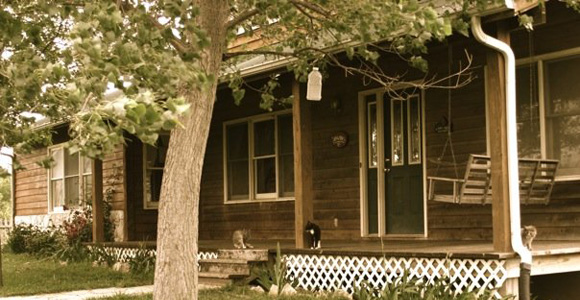
First of all, note that the front porch has no place in traditional architecture. It was a fleeting fad in the United States, first getting popular after the Civil War (c. 1865) and disappearing after the Second World War (c. 1950). When America's republican institutions were being founded, there were no front porches. Traditional Christian society in Europe never had front porches. I'll include some lovely images in this post to jog your memory, and you can check out this Web page, where I found most of them, to see more of the American architectural tradition. (Let me acknowledge: the untraditionalism of the front porch does not make it bad -- but it should make us think.)

The front porch's decline casts an interesting light on its rise. A key cause of the decline of the front porch, front-porch historians agree, was air conditioning. Climate control made it nicer to stay indoors than sit outside. A second cause was cars, which, with their noise and exhaust, drove people away from the front of their houses. A third reason, perhaps, was conspicuous consumerism, and the sense that the front porch looked too humble and old-fashioned -- ironically complimented by the cheapness of modern architecture, with its haste to cut unnecessary corners. A fourth was surely television, which made the indoors more entertaining. And a fifth, at least according to Deneen, was the transitory nature of post-automobile culture, where it no longer seemed worth the effort to get to know the neighbors.

Ironically, these reasons for the decline of the front porch also describe its beginnings.

Air conditioning drove people indoors -- but it was the heat that had driven them outdoors in the first place. It is worth noting that the front porch is originally a Southern institution -- historians think it may have been introduced by African slaves. Why had no one thought of this before? Well, everyone I've read agrees that a central part of the nineteenth-century evolution of the front porch was the advent of cheap building: previously, homes had been built of stone, which is naturally cool, but when they started being built more cheaply, other ways had to be found to beat the heat. (This is not central to my argument, but I note that the front-porch folks are usually pretty down on cheapness.)


In automobile culture, it is said, people had to flee to the back of the house when they wanted to be outside. But again, this highlights a significant irony. Historians agree that porches were initially put on the front of houses, not to be friendly to neighbors, but to hide from the back of the house. In the nineteenth century, that's where you kept the stinky horses and the outhouse. What's significant here is the motive for building front porches: purely utilitarian and private, not social. That doesn't change the social value of sitting out front, of course, but it should give one pause.

Television drew people indoors. What drew them out in the first place? Again, historians are unanimous: it was not a desire to socialize, but a desire to commune with nature, consistent with the nineteenth-century romanticism that created the Hudson Valley school of art and other forms of American naturalism. This point deserves further reflection, but before we move on, let us note in passing the connection to Deneen's claim that front porches declined when society got mobile: the time of the front porch was a particularly mobile part of American history, and it flourished most, not in the more stable towns of the East Coast, but in the West, where people were always on the move. One only needs to pick up a copy of Laura Ingalls Wilder, or peruse personal histories (I recently looked over the history of my Midwestern family) to see that these people couldn't sit still and were remarkably unpersuaded by the value of living close to family and old friends.

What drove the popularity of the front porch more than anything, say the historians, was a love of nature -- in fact, a way of thinking that explicitly opposed the dirt of man to the beauty of uncorrupt nature. Front porches were built, not to put people in contact with neighbors, but to help them glory in a world without neighbors. The front porch was a proclamation of glorious isolation, not republican community. Thus it is ironically consistent with the later-twentieth century's back porch, or patio: it was a way to be outside without seeing other people.

Indeed, a remarkable aspect of the front porch is that it goes hand and hand with a yard. In dense urban places where people don't have yards, front porches are almost impossible. And, from what I have seen of city living, where there are lots of neighbors around, it seems less pleasant to build a whole porch. Republic or no republic, people want a place to sit where there is some boundary between us and the world: whether an urban fence, a higher stoop, a balcony, or a suburban yard.

Having recently done some field research -- driving around old towns on the Hudson River where Victorian neighborhoods are still intact (I've done the same on the Shenandoah) -- it seems to me that late-Victorian suburban front porches were designed not to interface with the community but to help almost-city dwellers pretend they're out on the range. That's why these Victorian homes are built so far from the street, usually at a different elevation, and with as much yard as possible. The front porch as interface with the neighborhood is a lovely idea, but in fact, it was always used as a way to enjoy the distance of neighbors, cloaked, more or less perniciously, in the idea of nature's unsullied (that is, un-neighbor-ed) beauty.

I very much like Patrick Deneen's reasons for promoting the front porch, his ideas about life in community, an interface between public and private goods. But historically, I think the front porch better fits in with what the Greek political philosophers called "democracy" than with the idea of the res publica. Democracy means "mob rule," and the classic distinction is that a republic is about a common good, where individuals find their happiness in communion, whereas a democracy is about the majority snatching up private goods as fast as possible.


The front porch -- like the back porch -- is, historically, democratic, not republican. It's about individuals seeking pleasure through withdrawal from community. Perhaps it's no coincidence that the Victorian era, when the front porch was really popular, also saw the rise of progressivism, with its emphasis on destroying tradition and community in favor of a new kind of mass consumerism.

In place of the Front Porch, I submit the Sidewalk. In her magisterial The Death and Life of Great American Cities, Jane Jacobs lays out truly republican institutions. The chapter-headings of her first section make the point:
The Uses of Sidewalks: Safety
The Uses of Sidewalks: Contact
The Uses of Sidewalks: Assimilating Children
The Uses of Neighborhood Parks
The Uses of City Neighborhoods

City sidewalks are about people watching out for each other, people being in contact with one another, children getting to know the neighbors, and seeing fathers at work.

Mrs. Jacobs explicitly limits this discussion to big cities, but I've studied old small towns across the country -- from places like Pippen, Wisconsin (on the Mississippi, the town closest to Laura Ingalls Wilders's Little House in the Big Woods), to Putnam, Connecticut (a nineteenth-century mill town), to Staunton, Virginia, and Harper's Ferry, West Virginia (in the Shenandoah), to Bath, Pennsylvania (a farm town near the Applachians), to Newburgh, New York (on the Hudson) -- and one thing they all have in common is "urbanism." No matter how small, old towns are built around a dense core, where people give up their yards in order to live close together. Although it's a bit of an anachronism, we could say that what all old towns, small or big, have in common is the centrality of the sidewalk.

It is the sidewalk, not the front porch, that performs the republican functions Deneen so desires. It is the sidewalk, and the stoop, no matter how small, on front of the houses crowded against that sidewalk, that makes people neighbors.


The problem with the front porch is that it only exists where people are not crowded together. No yard, no porch -- and the yard, more than anything, shows a people who value privacy and separation from the neighborhood over communion and public life. Indeed, the problem with the yard is that it creates a world where no one walks. An urban environment, no matter the size, is defined by density and the close interface of work, leisure, and home -- so that people can walk from one place to another, and meet one another on the sidewalk.

Yards -- the almost-inseparable companions of front porches -- define neighborhoods where housing is separated from work and leisure (no one puts a yard in front of their store, or law office, or theater) and people define home by distance from other people. Yards add up quickly, killing the density that makes a neighborhood walkable and public.

And so the front porch, like the back porch, its successor, is not a republican institution, but a democratic one. However high-minded, the romanticism that fails to see this practical reality is the romanticism that has torn apart our vibrant urban neighborhoods.


Monday, January 25, 2010

Bumper Stickers

On a family car trip over the holidays, we were passed by a car with a pleasant bumper sticker about Jesus: nothing crazy, but clear, something like, "Jesus is Lord!"

As long time readers may remember, I am concerned about the anonymity of cars. We're so used to it that we don't notice, but sometimes it strikes me how truly nightmarish the highway is: surrounded by metal and glass, the world flying by at such a speed that we can't focus on anything, and only huge metal objects standing in the place of people. Science fiction could hardly conjure up a more dehumanized world.

So it momentarily struck me: perhaps bumper stickers are a good effort. If we can't talk to people, at least we can make clear that we are more than "Hyundai Elantra." Maybe in that depersonalized world, it's good to at least say something positive, and something that points to the transcendent. A bumper sticker could be a small step in the right direction.

But then it occurred to me. Little as I get to interact with other people on the highway, I am not entirely depersonalized. People see me driving the speed limit, and I see some of them crane their necks to see whether I am a little old lady or a middle-aged Chinese man. As little as I get to interact with them, they do see that I am neither of those things, and at least, perhaps, I raise the momentary question whether being a normal looking American requires that one ignore the law.

In that brief moment as they flash by, I think they get enough time to see the three car seats lined up across the back of our little hatch back. And I hope it at least raises a question, at least reminds them that some people still believe in family -- even choose family when it means we won't be able to afford a gigantic SUV.

I don't know what we look like from behind, but I think, during that minute it takes to get by us, that some people can see through our hatchback window the little wheelchair with my son's name emblazoned on it.

And I think, even in those brief glimpses of our humanity, it is perfectly clear that we are Christians.

Of course, I think it's all a lot healthier when we are pedestrians. Everyone on our block knows that we attend daily Mass: they see us, and talk to each other. (I know, because they tell me, in the bakery, where I actually talk to my real live neighbors.) Even if they've never talked to us, they know that we live by a different set of values, and they can guess pretty clearly what those values are.

So there's my bumper sticker, my "Jesus is Lord" t-shirt: my family, and the way I travel. Nothing against the guy with the bumper sticker, but I think we say it a lot more loud and clear.

Thursday, November 5, 2009

A Safe Place to Raise Our Children

One of the most compelling arguments against city living, I think, is the argument about protecting our children. A couple neighborhoods ago, we literally watched drug deals out our front window, right next to where our children play. The language was foul. Our immediate neighborhood was relatively safe, but shootings were frequent a few blocks away (anyone unfamiliar with the intense localism of city living would have said the shootings were in our neighborhood).

We live in a much better neighborhood now, but still there is pornographic graffiti all over the park. A very nice, but not very solid, neighbor gave our kids a bunch of comic books that were, ahem, not up to our standards of purity for our children's eyes. They weren't especially bad -- but it wasn't what I want my children to read. And if they get that stuff when they're four, it certainly makes me wonder what they will encounter when they're teenagers.

City life subjects us to all sorts of bad influences. It's no surprise that many people flee to the suburbs and the country, to protect their children.


But a recent discussion highlights the fallacy of that solution. My wife participates in an on-line community of homeschooling Catholic mothers -- diverse in many ways, but all solid Catholic moms, serious about doing what's best for their children. Recently a conversation came up that has come up many times before.

A mom writes in to say, hey, our closest parish is forty-five minutes away, but the priest is terrible; I'm getting to where I really can't subject my children to his bad preaching (or worse). And then they discuss their two or three options. In the many iterations of this conversation, there is typically an okay parish, but it's two hours away, and they're not sure they can make it to Mass every week (let alone every day). And lots of moms write in to say how they deal with similar situations.

We sit in our dense urban community, where we presently have (I do not exaggerate) eight parishes within a one-mile walk of us, and think, what an odd situation. Sometimes we try to think through the options, but end up shrugging our shoulders: it's hard to imagine having so few. At more lucid (or aggressive) moments, we think, if you really care about your children, maybe you shouldn't be putting your family in that situation. A thought, I suppose, parallel to what our peers in the country would say about us, if we complained about drug dealers and inappropriate magazines and graffiti: why don't you just move.

It is very uncommon for a family in the country to be bound there by a job -- jobs usually aren't any closer than parishes. Typically, they have moved to the middle of nowhere because they think it's a healthier environment for their children. But is it?


Perhaps they should live somewhere else. But where? Of course the immediate standard aspiration is, if only we could live in a tiny community where everyone is perfect. We know people who have tried to form such communities, in various situations: a suburban sub-development of only solid Catholics; a small town with one great parish; even, on occasion, attempts at building a farming community.

My first, and most natural, objection to those plans is on grounds of fideism. It is good to have Catholic friends and neighbors, to be sure -- but it's also good to have a soccer team, music teachers, theater, bookstores. It's good to have a decent hospital nearby (and I know people in these situations who have had major hospital problems, because their little utopia can't provide its own health care).

Dare I say it? It's even good just to have pagan neighbors, both to witness to and to learn from. In my experience, faith means more especially for children when they can see the depravity of their neighbors, the weakness of secular arguments, and even the frustration of the world around them -- when they care about people who don't have faith. A completely sheltered faith is not always the strongest faith. Some sheltering is necessary, of course -- but total sheltering from the outside world?

To put the same objection differently, lay people are not monks. There is an important place for those who flee the world and live only for prayer. But the Church is very explicit that such is not the vocation of the laity. We live to sanctify the world, to engage in politics, and culture, and labor, to witness to those who do not already have the faith. Abandoning that secular vocation of the laity is not good for grown-ups, and I do not see how it is a good way to teach children. The monastic vocation is itself corrupted (at least according to the teaching of the Catholic Church) if the world is treated as entirely evil. The laity are not monks, and monks need the witness of the laity.


But a second objection to the head-for-the-hills school of Christianity rests on the actual experience of monks. One cannot read far in monastic literature before one finds that even monasteries are not full of perfect people. St. Benedict, the founder of Western monasticism, was asked to lead more than one community that subsequently tried to kill him. That seems odd -- but it is the universal experience of monasticism. That has something to do with why monks are called monks -- from monos, alone: the monk submits to a rule, not because he thinks it will surround him with perfect people, but in order to seek God, as it were, on a single path. There are no communities of perfect people.

The experience of various Catholic communes makes this very concrete for the laity. I know quite well a small-town super-parish built almost entirely on the charisma of one man, a Ph.D. in theology. But that man is now senile, and dying. Now what? Is it good for a family to be in such need to one charismatic leader? And is that Catholic? To make things worse, the man's theology is not especially sound. He propounds many things as Church teaching which are not Church teaching, and which are sometimes directly contrary to Church teaching. My friends who are in this situation are not theologians; what can they do but submit to their hero's opinion? They are in good will: but they have put themselves in a situation where one man's error becomes their Gospel, because he is the only show in town.

Similarly, if we move to a perfect parish: what if the priest falls ill? What if he's weak on some points? Do these people realize that everyone has weaknesses, that the Church has never recommended that you submit yourself wholly to any mere mortal? (Even a monastic abbot is elected by the community, and hedged by many external authorities; and the classic understanding of monastic obedience is external not internal -- one always has the right to question the abbot's judgment, and so ultimately to leave, in extreme cases.)

A perfect suburban Catholic sub-development always runs the risk that one of the six families you've built your entire world around might turn out bad. There are no communities of perfect people.


That's not to say we shouldn't have friends. We should. We must. But friendship should lead us outward, into society. We should seek a place where we can make friends, not a place where we are left alone, whether to our own devices (in perfect rural isolation), or to fallible human pastors, charismatic leaders, and friends.

Living in the city subjects my family to certain risks, against which I must protect them. I might stay away from some graffiti, and from certain neighbors. I certainly need to train my children to discern right from wrong (though I submit that the drug dealers and playground graffiti really aren't all that tantalizing, especially to someone who has any life at all).

But in the city, I have resources. In the city, I don't have to be friends with everyone I see. In the city we can turn away from certain bad influences and towards others. In any form of commune, one can only flee from one bad influence by fleeing one's entire life. I just don't see how that makes for a safe place to raise our children.