Saturday, February 11, 2012

The Managerial Revolution


 My wife says I try to say too much in one blog post.  This will not be an exception. 


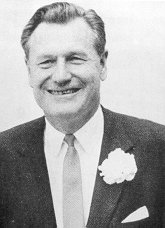
Nelson Rockefeller
I’ve been thinking about this post for awhile, and was originally going to call it “The New Rockefeller Republicans.”  After serving as Governor of New York, Nelson Rockefeller ran for every presidential election in the 1960s, and was eventually Gerald Ford’s vice president.  He had crazy amounts of money, and a kind of WASP-y (see my post four years ago on John McCain) noblesse oblige.  He supported the arts, achieved real progress in environmental conservation, greatly increased transportation and public housing, was tough on crime, especially drugs, but also fought valiantly against racial discrimination, while taking a decidedly moderate approach on abortion.  He was an enemy of ideology, ignoring the growing concerns in the 1960s and ‘70s that would become social conservatism, taking a friendly, accomodationist stance on foreign policy, and having a tin ear for questions of limited government.  He worked (at least in his mind) pragmatically for a better society.


But he was only at the center of a major mid-century movement.  Thomas Dewey, also governor of New York, ran for the presidency all through the 1940s, battling against the conservative wing of the Republican party, led by Robert Taft.  Put simply, Taft articulated a philosophy in opposition to FDR, Dewey did not.  Responsibility, pragmatism.

Dewey helped Eisenhower defeat Taft for control of the party in the 1950s.  Eisenhower was a pretty decent president – but thoroughly middle-of-the-road.  Central to Eisenhower’s presidency was the rising civil rights movement, in which Eisenhower fought hard for tolerance (not a bad goal) by sending federal troops into the states, while conservatives worried whether this goal was being achieved through destructively un-Constitutional means and an ever creeping federal State.

And Rockefeller passed the baton to George H.W. Bush, who condemned conservative philosophy as “voodoo economics,” ignored social concerns, and, for example with the Americans with Disabilities Act, continued to fight for a more pleasant easy-going world while ignoring concerns about the limits of government and the danger of perverse incentives.  (As the father of a wheelchair-bound child, I can tell you all about the glories and follies of the ADA – another time.)
New York mayor Michael Bloomberg

New York Mayor Michael Bloomberg is surely in this class, with his truly ridiculous crusades for public health, his general fight to make New York more pleasant – like a luxury hotel, he says – mixed with his general insouciance about economics and the limits of govenrment


Mitt Romney, with his maneuvering on abortion, unwillingness to take a strong stand on economics, and defense of a health care policy that ignored the dangers of creeping government – not to mention his apparent support from a class of “responsible,” non-ideological, “establishment” types, and even his Northeastern pedigree – has been labeled as the inheritor of the Rockefeller tradition.  But perhaps this new generation of Rockefeller Republicans has an important difference.

Please be clear: what follows is not intended as an endorsement (or rejection) of Romney, or of the movement of which he may be part.  It is simply an observation.  We must understand before making judgments.

Consider some of Romney’s peers.  Example One: Chris Christie, the fabulous governor of our great state of New Jersey.  Christie ran as a moderate; he was frankly dishonest with the people of New Jersey.  Once in office he led a charge to get the books in order, cutting spending especially by standing ferociously against the spend-thriftiness of the unions.  He has refused to raise taxes, but unlike the Reagan generation, who made tax cutting the prime concern and didn’t really worry about spending, Christie and his peers have refused tax hikes as an illegitimate excuse for runaway spending, but have kept their eyes on the bottom line, not on the philosophical goods of tax cuts.  Christie appears to be a Catholic in good standing and a pro-life social conservative, and he is one of America's most exciting politicians when it comes to dealing with urban problems – but that is not his focus.  He is just doing the responsible thing.  New Jersey has been living beyond its means for way too long, and it has to be stopped.  If Christie had to lie (or at least not tell the truth) to the voters in order to get elected, and if he has to ignore other good causes while fighting for these goals, so be it.

Rep. Paul Ryan
The same is true at the federal level.  Consider Paul Ryan, the great congressman from my home state of Wisconsin, and the de facto leader of the Republicans in Congress.  Ryan is a budget geek.  Again, he seems to be a pro-life Catholic, and I think he is in favor of lower taxes, but that isn’t his focus.  Ryan is worried about entitlement spending and how to get our books in order.


One of Christie’s closest friends is the governor of Indiana (and still my dearest desire from a contested convention), Mitch Daniels.  Daniels is a Presbyterian, but also apparently very pro-life and otherwise generally a social conservative.  But when contemplating a run for president last Spring (he decided not to run for personal reasons) he infamously called for a “truce” on social issues while we focus on the budget.  Many conservatives have responded that there can be no truce – witness the last week’s events, with Planned Parenthood whipping a breast cancer research organization into line, the Obama administration demanding that people with moral qualms about contraception, sterilization, and abortifacient drugs must pay for other people to get them, and the West Coast’s Ninth Circuit court ruling that there is a Constitutional right to define marriage however feels comfortable to social liberals.  But obviously Daniels had a point: we can focus more or less on these issues, and use more or less firey rhetoric even when taking a firm stand on actual policies.  Meanwhile, Daniels says, we face a new “red menace” – not Communism, but debt.  As governor of Indiana, Daniels is famous for cutting spending, finding new ways to finance freeways, battling the ever-voracious unions, and (everyone’s favorite!) making the DMV more efficient. 

The list goes on.  Scott Walker, governor of Wisconsin, is a pro-life Evangelical focused on fighting the irresponsibility of the unions (both the educational policies of the teachers and the general spend-thriftiness of all the public unions).  So is John Kasich, the governor of Ohio.

Mitt Romney can be read as part of this crowd.  Of course (perhaps) he is pro-life, pro-marriage, socially conservative, etc.  He has, after all, an exemplary family life, and is a leader in one of America’s most conservative churches.  But like Chris Christie, his biggest political booster, he has set everything else aside to fight the Red Menace.  Perhaps – I don’t know, but perhaps – he decided in Massachusetts that he would ignore all else, even lying about his position on abortion, in order to get the budget in order.  He was not great (though not bad) on taxes, not great on jobs (though he helped), and his decision on health care reform was not the best (though, I have to say, it is defensible, was the majority-conservative position before Obamacare – note that this was a non-issue when Romney ran in 2008 – and may have been the best that could be done in uber-liberal Massachusetts).  But he did balance the budget, taking Massachusetts from deep in red ink to a big rainy day fund. 

Romney explains his position on abortion

Perhaps Romney is actually the Chris Christie running for President.  Not running like Chris Christie was after the election, but running like Chris Christie was before the election.  Keep the focus on the other guy (Christie was also up against an unpopular mis-managing liberal), just tell people you’re responsible, don’t tell them just how radical you want to be, get what mandate you can, and then kick butt once you’re in office, hoping that you can accomplish enough in your first term to help the country, and maybe even win people’s affection (as Christie has in super-liberal New Jersey) when they can support what you’ve accomplished, and not what you’re threatening to accomplish.  Christie’s show-downs with the unions look a lot better in hindsight than in foresight.


Gov. Chris Christie
I’m not saying Romney has Christie’s skills – surely he does not have his pugnacity, for example.  But perhaps these new Rockefellers are of a different type.  Whereas Dewey, Eisenhower, Rockefeller, and Bush-41 just vaguely fought for a better, more welcoming world, without any sense of social or political philosophy, the new Rockefellers – Romney, Christie, Daniels, Ryan, Walker, Kasich, etc. – have a very strong social and political philosophy, but believe that this Red Menace is so dangerous that all else needs to be made secondary while we battle it. 

One interesting corollary of this belief is the way they relate to politics.  The old Rockefellers jumped on FDR’s bandwagon in thinking the way to get elected was to please everyone.  The new Rockefellers – hardly fair to even call them by his name, given their important differences – agree that you need the support of the masses: How else to get elected in the states with the biggest problems, like Massachusetts and New Jersey, or, as Daniels has said, to get a big enough mandate to do the enormous heavy lifting required for entitlement reform at the federal level?  But profoundly unlike the Rockefellers, these guys are not handing out goodies.  In fact, the only thing they are handing out is the bitter medicine of fiscal discipline.  The Rockefellers were popular for popularity’s sake.  The Christie-Daniels Republicans are trying to appease enough people that they can whip us into order.

To close – and lest my wife relinquish her claim that I try to say too much in one post – I would like to make a wild prediction about the twenty-first century.  I have previously argued a cockamamie theory that each century has its peculiar revolution and character – typically with foreshocks at the end of the previous century and the real avalanche in the second decade of the century.  The eighteenth century had its somewhat unreasonable hopes for reason.  The nineteenth century (focusing here on America) began with the Constitution, but settled in with the Virginia dynasty, and then especially General Jackson’s election in 1828.  It was a century of “republicanism”: a belief that, rightly ordered, the common man could be defended by a proper constitution.

I recently attended a political science conference in which nineteenth-century-Americanists pointed out that the idea of democracy was anathema to the nineteenth century.  Democracy is mob-rule.  Everything in the Constitution – read the Federalist Papers! – is organized to prevent democracy, to make sure that the 51% cannot inflict their prejudices and self-interest on minorities of various sorts.

The twentieth century, with tremors in the late-nineteenth-century populism of William Jennings Bryan and real victory in the Constitutional Amendments of the 1910s, turned that consensus upside down.  Now (yes, still now, for the twenty-first has hardly begun) most Americans cannot even conceive of someone being opposed to majority rule and direct votes.  But we are beginning to wake up to the damage done by this way of thinking.  The ravages of consumerism, to be sure -- of, for example, supposing that if everyone's enjoying the Super Bowl halftime show, it must be okay.  But even more, the ravages of government give-aways, where pandering politicians sell the good of the nation short in exchange for a few more votes.  Populism has had its day, and its successes and failures.  (A post for another day: how rich are we really – when the bill comes due?) 

And so, perhaps, the twenty-first century will be the age of the managers.  Men like Chris Christie and Mitt Romney, Mitch Daniels and Paul Ryan, who set aside populist rhetoric, set aside even a true portrayal of themselves to the voters, in order to better manage the country.  Romney is portrayed by his opponents as wanting to “manage the decline.”  But the belief of these new managers is that management is the only way to avoid decline. 

The same kind of people have taken over my university – this is anecdotal, but perhaps significant.  Our new president and provost have very little to say about education, but lots to say about management, including, above all, getting our books in order.  (Even in the university, "books" now means finances.)  As I recall, even when I was a grad student at the Catholic University of America – which was undergoing a profound rediscovery of its religious and intellectual mission – we got a new Provost interested not so much in education as in management.  Consider the irony of schools changing this job’s title to “Chief Educational Officer”: on one level, it claims to be about education, but in fact, it’s a title out of management theory.

Good or bad?  Well, a bit of both.  It’s not my point to endorse it or condemn it, but to say, watch it come.  These guys are right.  The twentieth-century’s obsession with democracy left a major deficit of serious management.  Perhaps the next century will see us give up on cult-of-personality populists trading handouts for votes, in favor of boring technocrats who let us ignore the grime of politics while they fix the problems.  I think there are ways of defending this way of life – far from Big Brother, most of these technocrats seem also to realize, for example, the importance of the family, the local community, and personal responsibility, and might be expected to overrule the ever-expanding if-it-feels-good-do-it-ism of the twentieth-century.  Super-manager Mitch Daniels insists that the goal is not more power for him, but less; his book is subtitled, "Saving America by Trusting Americans."  There are abundant economic and social corollaries to a shift from mob-rule to management.  But for now, I’ll leave it here.

Mitch Daniels


Thursday, January 12, 2012

Bartleby


I have just finished Herman Melville’s short novel Bartleby the Scrivener. My reasons for reading it were two: I know nothing about Melville, nothing even about his period, except that he is supposed to be very good.  And the book was free and short on Libra Vox, so I could listen to it in the car.

Bartleby is written in the first person, describing the consternation of a Wall St. lawyer who hires a very strange secretary, for whom the book is named.  Bartleby is passionless—he is contrasted with other, colorful characters, the secretaries Turkey and Nippers and the office boy Ginger Nut, precisely to show how colorless he is. 

He falls into ever deeper depondency.  Increasingly, when asked to do various parts of his job, he responds with the book’s refrain, “I prefer not to.”  The narrator discovers that Bartleby is living in the office, apparently without friends, without anywhere to go, and without much food. 

A scrivener who “prefers not to”—not even to talk about himself—is pretty annoying, and upon pressure from other business people who pass through, the narrator decides to get rid of him.  The book reaches a peak of absurdity when the narrator, who cannot bring himself to call the police, moves offices so as to escape from a Bartleby who prefers not to leave—only to have his former landlord hunt him down and demand that he find a way to get Bartleby out of the building.

The narrator can never quite bring himself to do Bartleby harm.  In fact, he repeatedly offers him money, one time putting it in his hand, only to watch it fall to the floor.  But when Bartleby prefers not to engage any other opportunities, even an offer to come home with the narrator(!), the landlord finally has him taken to jail.  Despite the narrator’s arrangements with the prison grub man, Mr. Cutlets, to provide Bartleby with the best of food, Bartleby prefers not to eat.  The narrator finds him dead, as if asleep, in the prison yard.

I know nothing of this period in American literature, which perhaps strengthened the effect of the book on me.  Even as Bartleby died, it was still unclear to me whether this was a work of black irony or of Christian compassion.  The story is certainly absurd.  But it closes with the narrator hearing a rumor that Bartleby used to work in Washington at the “dead letter office,” processing undeliverable mail. 

His job was to remove valuables—rings or money, perhaps—from letters that never reached their intended recipients: a long meditation on futility and unbreachable distances between those who would profess their love.  The narrator surmises it is this meditation that led Bartleby to despondency.  And so, on the last page of the book (or last minute of the recording), we are overwhelmed with the sadness of a man who has so deeply felt the pain of this world that he is finally judged by others to be unworthy to live in it.


I happened to listen to the last section of Bartleby while running errands with my seven-year-old son and five-year-old daughter.  They of course couldn’t follow all of the story—I had listened to the whole thing, and understood the language, and still wasn’t sure what was going on until the very end—but my daughter, especially, thought the refrain “I prefer not to” pretty humorous.  And I think they, too, were caught up, as I and the narrator himself were, in the riddle of Bartleby. 

Perhaps ten minutes before the end of the book, we were driving through an especially rough part of Newark.  On a desolate corner stood a black man in ragged clothing, with an odd assortment of bags around him.  It wasn’t clear what he was up to, but my daughter proposed, after we’d gone past, “Daddy, I think I just saw one of those men who is too poor to have any home to go to.” 

This, I think, is not the least of the virtues of city living.  My children know about, and recognize homelessness.  It is familiar enough to them that they do not cringe—I was recently in a better part of Newark with a suburban friend, who professes to hate cities, and who was shocked when my wife failed to notice a somewhat derelict looking crowd of black men as she was proclaiming the safety of our neighborhood. 

To be a Christian, to be even human, I think, is above all to have compassion for the riddle of Bartleby.  

Friday, September 23, 2011

Land of Sorrows

New Jersey.  We've lived here for a little over two years now, in Newark, which has long been the biggest city, in a neighborhood that was, not all that long ago -- 150 years? -- a swamp, but has been filled with poor immigrants ever since, and is the one part of the city spared from the destruction that has come upon so many of America's cities.

What do you think when you think New Jersey?  Brash.  Fast driving.  Nasty lawyers. (Yes, they're here!)  Guido's and Guidette's on the beach.  Unpleasant people.

But let's go a little deeper.

Philadelphia's Benjamin Franklin famously called New Jersey a "beer keg, tapped at both ends."  That may seem to sum up New Jersey as a place of swill and hangovers, smelling like an "arm pit" (one of the more pleasant evocations of our state - there is actually a campaign that feels the need to cry out "New Jersey doesn't stink!").  But Benjamin Franklin was also the one who said, "beer is living proof that God loves us and wants us to be happy."

Early reports of New Jersey are of a paradise, a garden state, a place of rich farms and, yes, great breweries.  I don't know much about the Channel Islands, between England and France, but when I think of old Jersey, I think of a farming paradise -- and that's what this state was like.  It was a keg you wanted to get into.

But it was also a keg tapped at both ends.  New Jersey has always been the land between Philadelphia and New York.  Today we have no media markets of our own -- part of the reason our politics are so screwed up -- because most of the state is part of metropolitan areas centered in other states.  On the one hand, that means money has always flowed in from Philadelphia and New York.  On the other hands, it means we have always been serving someone else.


Today, the state is divided according to which city you commute to, and traversed by I-95, which literally runs across the state from Philadelphia to New York City; the New Jersey Turnpike, which extends from 95 to bypass Philadelphia on the way to Wilmington, Baltimore, and Washington, DC; and the Garden State Parkway, which reaches down the Shore, bringing tourists in and out.  Originally, the primary road was the the old Post Road, authorized by the Constitution, and formerly the King's Highway, running from Philadelphia to New York.  We are a state rich in natural resources, but fundamentally In Between.

New Jersey was born of compromise and division.  The Swedes were actually the first to settle, in the southern part of the state.  Then we were part of New Netherlands, along with what is now New York and the western half of Connecticut.  Even then, the Dutch milked this land for resources, without really investing.  New Jersey proper was born of protest.  England's King Charles II -- himself the victor of a Civil War -- purchased the country from Holland, and gave it over to his brother, the Duke of York and the future King James II.  James, of course, was the one deposed by (ironically, the Dutch) William of Orange and Mary.  He was deposed because he was Catholic.  New York was named for this man who might have returned England to the faith of her fathers.  New Jersey split off in protest.  Thus Princeton, the original College of New Jersey, has always been a center of Calvinist Presbyterianism precisely because New Jersey was the land to which all the pious Dutch fled when it appeared that New York might go papist.  I teach in a town called Orange; it is not named after fruit.

New Jersey was the crossroads of the Revolutionary War.  Our city of Newark was founded in 1666.  By 1776 -- not that much later -- George Washington was stopping here as he fled from the massacres that were the British capture of New York City, on his way down to the Pennsylvania side of the Delaware River, from which he would run various raids back into New Jersey.  Trenton eventually got to be our capital in large part because of the glorious battle fought there -- after Washington's famous Christmas crossing of the Delaware, from Pennyslvania into New Jersey, to slaughter the Hessians.  Washington's earlier stop at Newark is famous in large part because it was apparently here that Thomas Paine wrote those famous words (I will quote beyond the famous part, to give the flavor):
THESE are the times that try men's souls. The summer soldier and the sunshine patriot will, in this crisis, shrink from the service of their country; but he that stands by it now, deserves the love and thanks of man and woman. Tyranny, like hell, is not easily conquered; yet we have this consolation with us, that the harder the conflict, the more glorious the triumph. What we obtain too cheap, we esteem too lightly: it is dearness only that gives every thing its value. Heaven knows how to put a proper price upon its goods; and it would be strange indeed if so celestial an article as FREEDOM should not be highly rated. Britain, with an army to enforce her tyranny, has declared that she has a right (not only to TAX) but "to BIND us in ALL CASES WHATSOEVER" and if being bound in that manner, is not slavery, then is there not such a thing as slavery upon earth. Even the expression is impious; for so unlimited a power can belong only to God.
Consoling words, I suppose--but consolation only in the face of desolation.  For seven-odd years, the armies tramped back and forth over New Jersey, burning farms, raping civilians (the Hessians were especially known for that, though the British were pretty proud of themselves too), devastating towns -- anyone who could, sure got out of Trenton.  If New Jersey was a place of victory, it was only because it was a land of continual slaughter.

The army battles of the Civil War did not hit New Jersey.  But the civil battle certainly did.  Southern Jersey extends south of the Mason-Dixon line, and even up here in Newark, there were very strong business connections to the South.  New Jersey was torn apart.

In the later nineteenth century, New Jersey was at the heart of the Industrial Revolution.  Thomas Edison was here, Paterson was the home of the silk industry and the original manufacturers of Colt rifles, and a huge proportion of America's leather products were made in Newark.  Newark also produced the first plastics, had and produced the first electric lights, and, because it was so ahead on these manufacturing things, hosted the birth of the insurance industry in the late nineteenth century.  A rich and prosperous state.

But you cannot understand New Jersey -- or New York City, or probably any of the Northeast -- without understanding immigration.  Wave after wave of Europe's poorest people poured into our cities.  They came here to work, and they did work, and rose from poverty.  But it wasn't easy, and it wasn't comfortable.  More on that, perhaps, in another post.

Eventually the blacks came, too, in the two Great Migrations (first from 1910-1930, then from 1941-1970).  They came here, like all the other immigrants, because New Jersey was a land of opportunity.  But they were not always respected, and the political classes did not treat them well.  The destruction of the cities is a topic I have covered elsewhere; suffice it to say that it was devastating to the millions of blacks who had come to work in New Jersey.  It was somewhat less devastating to the European immigrants, but their communities, too, were destroyed.  Newark's old First Ward, once a truly vibrant, and truly Italian community, was razed to the ground, replaced by government housing projects full of blacks, many of them without much hope of advancement.  Weequahic, the southern most part of the city, went from having at least as much claim to be a true homeland for the Jews as Israel itself, to a place where this past summer a police officer was accidentally killed after two girls -- black, and hopeless -- got in a fight, and one of them sent her boyfriends to gun down the other one's boyfriends in a pizza place.  Newark, and New Jersey, is a place of scars.

The riots were both cause and effect.  To live in Newark is to hear constantly of those July days in 1967 -- and to see the physical scars that remain across the city, the blocks piled with rubble, the boarded up houses and buildings, the ancient billboards advertising a glamourous city that it strains one's imagination to believe could ever have been Newark.  The Italians who stayed, and those who left, remain in shock and terror at what happened to their home, their city.  But the riots were not the beginning - they hardly could have been.

New Jersey, this garden state, this industrial masterwork, this place of opportunity and beauty, has always been bleeding.  It is a true crossroads of America, and like Belgium, that means it has been crossed by every kind of army in every kind of war. For a hundred and fifty years now wave after wave of impoverished immigrant has come, bringing with them the pathologies and desperations of their home countries, the clash of cultures that have never met before, the desperate effort to get ahead.  New Jersey, I sometimes feel, is like we're still on the boat, with everyone gasping for air, stepping on one another to try to survive, and to get to where the land of riches must surely be.  In New Jersey, the rich themselves came from the poverty of the docks of Naples, and continue to act like it.  And meanwhile, every generation looks down on, and does their best to take from, the generation after it: the WASPs have always tried to hold their power, and to get rich off of the immigrants, and each generation of immigrants follows that pattern.  It is a frightful place, because it is a bleeding place.

Please don't misunderstand me.  I love the immigrants, including those black immigrants from America's South -- I choose to live in an immigrant neighborhood, in a black city. I write not to condemn, but to compassionate.  I feel the terror, the frustration, the scars.  And I believe this is America, at its deepest, and richest, and most difficult.

Today is the feast of St. Pio of Pietrelcina, "Padre Pio," a Franciscan friar in Italy in the early- to mid-twentieth century.  He was a man of compassion and of suffering, and for his compassion he was made to suffer, cast out of his community, silenced, abused.  I heard a priest say Mass today who in many ways embodies my understanding of New Jersey.  He talks like a man born and raised here -- but he also says the Italian Mass at our parish, reminding us that he is the son of immigrants, who grew up in a home where they didn't speak English.  He grew up in Newark -- and not our part of Newark, which was spared.  His parish has been bulldozed, his community is gone; the center of the riots was walking distance from his home.  When he comes to say the Italian Mass, we know it is with a suffering nostalgia.  After the riots, his parents moved out to the very borders of Newark, to a kind of hiding place, but still within this beloved, bleeding city.

I don't know the rest of his story.  I know that he had a mental breakdown after his mother died, that he is a man whose holiness -- if I am right in thinking it is holiness -- is precisely in his utter forsakenness, his complete loss of interest in amounting to anything.  Recently we were chatting, somehow, about Monsigniori.  He said, "not for me.  'Monsignor' is for mothers.  My mother is dead."  His preaching, like the way he says Mass and hears confessions, always carries the resignation of a shrug: he does things right, but makes no effort to do them particularly well.

But today he spoke with unaccustomed eloquence about St. Pio.  A man he said he identifies with -- I have NEVER heard this priest say he identifies with anything related to sanctity! -- though he then tried to cover it up, saying we all probably feel some kinship with Padre Pio.  And then he talked about how Padre Pio got nothing but suffering, nothing but rejection, for all the good he did.

A land of sorrows.  New Jersey.

Thursday, September 8, 2011

Nature and Aesthetics in Brideshead

I am teaching Evelyn Waugh's wonderful novel Brideshead Revisited right now. I'd like to share some thoughts about aesthetics.

Early on at Oxford, Charles, the future landscape painter, learns something critical:

It was not until Sebastian, idly turning the pages of Clive Bell's Art, read: "'Does anyone feel the same kind of emotion for a butterfly or a flower that he feels for a cathedral or a picture?' Yes. I do," that my eyes were opened.
Modernity claims a radical divide between nature and man. Indeed, in modern parlance, nature is almost defined as "untouched by man" -- and thus man defined as "not nature." That isn't true, on a variety of levels. Sebastian teaches Charles that it isn't true on the aesthetic level. Art is beautiful precisely because it is an extension, a further development, of nature.

Anthony Blanche was the first to go . . . . The others left soon after him. I rose to go with them, but Sebastian said: "Have some more Cointreau," so I stayed and later he said, "I must go to the Botanical Gardens."

"Why?"

"To see the ivy."

It seemed a good enough reason and I went with him. He took my arm as we walked under the walls of Merton.

"I've never been to the Botanical Gardens," I said.

"Oh, Charles, what a lot you have to learn! There's a beautiful arch there and more different kinds of ivy than I knew existed. I don't know where I should be without the Botanical Gardens."
A beautiful arch, and more kinds of ivy than I knew existed. Does anyone feel the same kind of emotion for a man-made arch as for the brilliant natural variety of ivy? Yes. Sebastian does. And really, it's not hard to see it. Of course there is a beautiful arch among the ivy.

Then they go to Brideshead.

It was an aesthetic education to live within those walls . . . to sit, hour after hour, in the pillared shade looking out on the terrace.

This terrace was the final consummation of the house's plan; it stood on massive stone ramparts above the lakes, so that from the hall steps it seemed to overhang them, as though, standing by the balustrade, one could have dropped a pebble into the first of them immediately below one's feet. It was embraced by the two arms of the colonnade; beyond the pavilions groves of lime led to the wooded hillsides. Part of the terrace was paved, part planted with flower-beds and arabesques of dwarf box; taller box grew in a dense hedge, making a wide oval, cut into niches and interspersed with statuary, and, in the centre, dominating the whole splendid space, rose the fountain; such a fountain as one might expect to find in a piazza of Southern Italy, such a fountain as was, indeed, found there a century ago by one of Sebastian's ancestors; found, purchased, imported and re-erected in an alien but welcoming climate.

Sebastian set me to draw it. It was an ambitious subject for an amateur -- an oval basin with an island of formal rocks at its centre; on the rocks grew, in stone, formal tropical vegetation and wild English fern in its natural fronds; through them ran a dozen streams of counterfeited springs, and round them sported fantastic tropical animals, camels and camelopards and an ebullient lion all vomiting water; on the rocks, to the height of the pediment, stood an Egyptian obelisk of red sandstone -- but, by some odd chance, for the thing was far beyond me, I brought it off and by judicious omissions and some stylish tricks, produced a very passable echo of Piranesi . . . .

Since the days when, as a school-boy, I used to bicycle round the neighbouring parishes, rubbing brasses and photographing fonts, I have nursed a love of architecture, but though in opinion I had made that easy leap, characteristic of my generation, from the puritanism of Ruskin to the puritanism of Roger Fry, my sentiments at heart were insular and mediaeval.

This was my conversion to the baroque. Here under that high and insolent dome, under those tricky ceilings; here, as I passed through those arches and broken pediments to the pillared shade beyond and sat, hour by hour, before the fountain, probing its shadows, tracing its lingering echoes, rejoicing in all its clustered feats of daring and invention, I felt a whole new system of nerves alive within me, as though the water that spurted and bubbled among its stones was indeed a life-giving spring.

Where does nature leave off and art begin? Of course on some level there's a distinction -- but true art springs right out of nature, and ties it together.

Indeed, sometimes nature itself becomes art. Here is Charles returning to Brideshead in war time:
Beyond and about us, more familiar still, lay an exquisite man-made landscape. It was a sequestered place, enclosed and embraced in a single, winding valley. Our camp lay along one gentle slope; opposite us the ground led, still unravished, to the neighbourly horizon, and between us flowed a stream -- it was named the Bride and rose not two miles away at a farm called Bridesprings, where we used sometimes to walk to tea; it became a considerable river lower down before it joined the Avon -- which had been dammed here to form three lakes, one no more than a wet slate among the reeds, but the others more spacious, reflecting the clouds and the mighty beeches at their margin. The woods were full of oak and beech, the oak grey and bare, the beech faintly dusted with green by the breaking buds; they made a simple, carefully designed pattern with the green glades and the wide green spaces -- Did the fallow deer graze here still? -- and, lest the eye wander aimlessly, a Doric temple stood by the water's edge, and an ivy-grown arch spanned the lowest of the connecting weirs. All this had been planned and planted a century and a half ago so that, at about this date, it might be seen in its maturity. From where I stood the house was hidden by a green spur, but I knew well how and where it lay, couched among the lime trees like a hind in the bracken.

A "man-made landscape." What can it mean? Well, this. Where does nature leave off and man begin? How can it be that the Doric temple (with its ivy-grown arch!) ties together the play of landscape, that the house itself is like a deer, grazing among the woods?

Note, also, before we move on, the play of political life: the fountain has been brought to this rural setting, but it immediately evokes the piazza in Southern Italy that was its natural home, while Brideshead ties in a farm up river, and indeed a whole community of farmers, while leading the mind down river toward Bristol, a major city, at the mouth of the Avon. To see this natural place is to see its connections to the human world around it.

But now it is time to talk of food. Who could forget that dinner with Rex at Paillard's. Like Charles, let us tune out Rex's awful noise, and attend to the beautiful:

I was there twenty minutes before Rex. If I had to spend an evening with him, it should, at any rate, be in my own way. I remember the dinner well -- soup of oseille [the herb sorrel], a sole quite simply cooked in a white wine sauce, a caneton a la presse [duckling pressed, then cooked in its own juices], a lemon souffle. At the last minute, fearing that the whole thing was too simple for Rex, I added caviare aux blinis. And for wine I let him give me a bottle of 1906 Montrachet, then at its prime, and, with the duck, a Clos de Bere of 1904.
Living was easy in France then; with the exchange as it was, my allowance went a long way and I did not live frugally. It was very seldom, however, that I had a dinner like this, and I felt well disposed to Rex, when at last he arrived and gave up his hat and coat with the air of not expecting to see them again. He looked round the sombre little place with suspicion, as though hoping to see apaches or a drinking party of students. All he saw was four senators with napkins tucked under their beards eating in absolute silence. I could imagine him telling his commercial friends later: ". . . interesting fellow I know; an art student living in Paris. Took me to a funny little restaurant -- sort of place you'd pass without looking at -- where there was some of the best food I ever ate. There were half a dozen senators there, too, which shows you it was the right place. Wasn't at all cheap, either."
Well, Rex understands some things.
He plainly wished to talk of his own affairs; they could wait, I thought, for the house of tolerance and repletion, for the cognac; they could wait until the attention was blunted and one would listen with half the mind only; now in the keen moment when the maitre d'hotel was turning the blinis over in the pan, and, in the background, two humbler men were preparing the press, we would talk of myself . . . .

"Ah." The cream and hot butter mingled and overflowed separating each glaucose bead of caviar from its fellows, capping it in white and gold.

"I like a bit of chopped onion with mine," said Rex. "Chap-who-new told me it brought out the flavour."

"Try it without first," I said. "And tell me more news of myself."
Glaucose is a shade of grey. Cream, butter, caviare, thin blini pancakes. Good cooking begins and ends with natural ingredients, gentle shades of flavor and color, gently brought together, so that each complements and nothing overpowers.
The soup was delicious after the rich blinis -- hot, thin, bitter, frothy.
But Rex is still talking.
"It's the kind of thing I hear . . . . But Ma Marchmain won't do anything about it. I suppose it's something to do with her crack-brain religion, not to take care of the body."

The sole was so simple and unobtrusive that Rex failed to notice it. We ate to the music of the press -- the crunch of the bones, the drip of blood and marrow, the tap of the spoon basting the thin slices of breast
The sole was so simple and unobtrusive that Rex failed to notice it. The pun is exquisite. Rex criticizes Lady Marchmain for a religion that, by his calculation, does not sufficiently care for the body. That seems "crack-brain" to him because -- well, because the soul is so simple and unobtrusive that Rex fails to notice it. He is bodily in a gross way, in a way that cannot appreciate the soul. But ironically, his grossness also cannot appreciate the body, for just as he overlooks the soul, so too does he overlook the fish, the sole.

The true contrast is not between body and soul, but between gross and fine. Nothing could be more physical than the crunch of bones as they prepare that delicate caneton. But it is a music Rex cannot hear.

Who can fail to think of that lovely dinner with Cordelia at the Ritz Grille in London, after a day of painting poor doomed Marchmain House, some eighteen months later.

"I hope I've got a vocation."

"I don't know what that means."

"It means you can be a nun. If you haven't a vocation it's no good however much you want to be; and if you have a vocation, you can't get away from it, however much you hate it. Bridey thinks he has a vocation and hasn't. I used to think Sebastian had and hated it -- but I don't know now. Everything has changed so much suddenly."

But I had no patience with this convent chatter. I had felt the brush take life in my hand that afternoon; I had had my finger in the great, succulent pie of creation. I was a man of the Renaissance that evening -- of Browning's Renaissance. I, who had walked the streets of Rome in Genoa velvet and had seen the stars through Galileo's tube, spurned the friars with their dusty tomes and their sunken, jealous eyes and their crabbed hair-splitting speech.

"You'll fall in love," I said.

"Oh, I pray not. I say, do you think I could have another of those scrumptious meringues?"
Who has their finger in the succulent pie of creation? Still-secular Charles has seen something extraordinary in his painting. But so has Cordelia. A page before we read:
Presently on the last afternoon I heard a voice behind me say: "May I stay here and watch?"

I turned and found Cordelia.

"Yes," I said, "if you don't talk," and I worked on, oblivious of her, until the failing sun made me put up my brushes.

"It must be lovely to be able to do that."

I had forgotten she was there.

"It is."
So here's this fifteen-year-old girl who can sit in absolute silence and enjoy all the glories of the Renaissance man. He thinks her religion of friars stands between her and the joy of creation. She wants to be a nun and finds meringues scrumptious.

But let us return to Paillard's:
Those were the kind of things he heard, mortal illness and debt, I thought.
I rejoiced in the Burgundy. How can I describe it? The Pathetic Fallacy resounds in all our praise of wine. For centuries every language has been strained to define its beauty, and has produced only wild conceits or the stock epithets of the trade. This Burgundy seemed to me, then, serene and triumphant, a reminder that the world was an older and better place than Rex knew, that mankind in its long passion had learned another wisdom than his. By chance I met this same wine again, lunching with my wine merchant in St. James's Street, in the first autumn of the war; it had softened and faded in the intervening years, but it still spoke in the pure, authentic accent of its prime and, that day, as at Paillard's with Rex Mottram years before, it whispered faintly, but in the same lapidary phrase, the same words of hope.
Another wisdom than his. The fabulous thing about viniculture is how it mingles man's wisdom with the wisdom of nature. Like the designer of English parks, the vintner gently harvests the fruit of the earth, pared through generations into subtly different grapes, and allows the yeasts that already inhabit the skins to gently work their magic, sometimes over decades (the wines that night at Paillard's were about twenty years old), in barrels themselves carefully cultivated from just the right oak. Where does nature leave off and art begin? The wisdom of the vintner is an ancient wisdom, slowly gleaned from the wisdom already built into the earth itself by its wise creator. It is a kind of contemplation, and it speaks words of hope that the world is an older and better place than Rex ever knew.

After the duck came a salad of watercress and chicory in a faint mist of chives. I tried to think only of the salad. I succeeded for a time in thinking only of the souffle. Then came the cognac and the proper hour for these confidences . . . .

The cognac was not to Rex's taste. It was clear and pale and it came to us in a bottle free from grime and Napoleonic cyphers. It was only a year or two older than Rex and lately bottled. They gave it to us in very thin tulip-shaped glasses of modest size.

"Brandy's one of the things I do know a bit about," said Rex. "This is a bad colour. What's more, I can't taste it in this thimble."

They brought him a balloon the size of his head. He made them warm it over the spirit lamp. Then he rolled the splendid spirit round, buried his face in the fumes, and pronounced it the sort of stuff he put soda in at home.

So, shamefacedly, they wheeled out of its hiding place the vast and mouldy bottle they kept for people of Rex's sort.

"That's the stuff," he said, tilting the treacly concoction till it left dark rings round the sides of his glass. "They've always got some tucked away, but they won't bring it out unless you make a fuss. Have some."

"I'm quite happy with this."

"Well, it's a crime to drink it, if you don't really appreciate it."

He lit his cigar and sat back at peace with the world; I, too, was at peace in another world than his. We both were happy. He talked of Julia and I heard his voice, unintelligible at a great distance, like a dog's barking miles away on a still night.

A fine coup de grace: even antiquity is not a think to be sought for its own sake, just because a bottle has Napoleonic cyphers on it. Indeed, the truer antiquity is the wisdom that knows when to bottle and when to drink, and how to appreciate the subtler stuff. Antiquity itself is a heroic deed of man -- Napoleonic indeed -- but beauty is a knowledge of something beyond man, the cultivation of a wisdom that does not start with us.

Monday, July 4, 2011

The Declaration of Independence

We all know the opening salvo (after a brief preface, “When in the Course of human events”), of the document we celebrate on the Fourth of July:

“We hold these truths to be self-evident, that all men are created equal, that they are endowed by their Creator with certain unalienable Rights, that among these are Life, Liberty, and the Pursuit of Happiness. – That to secure these Rights, Governments are instituted among Men, deriving their just powers from the consent of the governed.” Etc.

Although Jefferson’s words have something of inspiration about them, the subsequent two centuries and more of the Republic – and of much of world history – have largely been a debate about what these things mean. What are Rights? What do Liberty and the Pursuit of Happiness mean? How does Government “secure” rights? What does “Government” even mean?


One example, that I happened upon this morning. James Madison, surely one of the more important

founding thinkers, wrote in that seminal Federalist no. 51, “If men were angels, no government would be necessary. If angels were to govern men, neither external nor internal controls on government would be necessary. In framing a government which is to be administered by men over men, the great difficulty lies in this: you must first enable the government to control the governed; and in the next place, oblige it to control itself.”

Now, coming from a Thomistic perspective, I find myself constrained, in order to give a philosophically coherent account of this business about “angels,” to make some points that may more properly belong to theology. And I preface this by saying that, as a means of interpreting what James Madison meant, I think the following resort to Thomistic angelology is highly dubious. But perhaps his insight was better than his explicit understanding.

“If men were angels” is typically taken, I think, to mean “if men were saints,” or at least “if men weren’t sinners.” I was recently in a debate with someone (an American Orthodox libertarian with a Harvard Ph.D. in political science: i.e., someone who knows Madison but whose thinking on nature and grace may be a little cavalier). Paraphrasing this line from Madison, I think, he claimed that government would be unnecessary if not for the Fall.

But that, says Thomas, following Aristotle, is not true. Government is necessary if we live in community. Government needs to use force only if people wickedly resist it – and my interlocutor tells me that since Max Weber, it has become typical to define Government as force. But common life demands decisions: what side of the road will we drive on? When shall we celebrate our festivals? How shall we raise money for the common fund? Where should we build roads, and public buildings, and how shall we adjudicate legitimate disputes among private citizens? What causes shall we pursue, and when? As the great Thomist Aristotelian Yves Simon argues, in A General Theory of Authority, the common life demands authority, whether it be the authority of a king or that of a congress or even that of a majority.

The key point, then, in saving Madison’s claim that “if men were angels, no government would be necessary,” is that angels differ essentially from men not in being good, but in being immaterial (and, Thomas takes it to a deeper metaphysical level, each of a separate species). Good men would need government, even though the government would never have to force compliance with its decisions. “Men” without bodies –angels – would not need government, because they would not live in a common world.

But government must have limits – unless the governors themselves were angels: “If angels were to govern men, neither external nor internal controls on government would be necessary.” Well, if “controls” means threats of violence against the governors, then I suppose saints would not need controls. But if it means, in the classic American sense, just a clear sense of limits, then the essential difference is again one of materiality.

Government must be limited, it is true, because governors are always in a certain sense corrupt. But as the founding fathers never tired of saying, there is no way to control a society of vicious people— as Madison put it, at the Virginia ratifying convention, “Is there no virtue among us? If there be not, we are in a wretched situation. No theoretical checks – no form of government can render us secure.”

The genius of the American scheme of limited government, however, is to realize that even virtuous men have limits on their competence. Why? Because no man knows all. No distant bureaucrat, no matter how good or ingenious, can know enough to decide how best to educate my particular children, to manage my health, to bring my neighborhood to life. For us mortals, knowledge begins in the senses: there can be no knowledge, and thus no practical wisdom, without feet on the ground in the relevant place.

So the goal is not to find “angels” of men – that is, saints – who can govern us without limits. We do need good men, but that is not enough. We also need to define the limits of what government at different levels can do. That is the genius of Article One, Section Nine of the American Constitution. On a deeper level, it is the genius of the division of powers, Articles One-Three, and so the bulk of the American idea.

(And so, in one of the more brilliant lines of American jurisprudence, now-Chief Justice John Roberts, in a decision overturning the intrusions of the EPA, wrote, “a hapless toad, for reasons of its own, lives its entire life in California” – and is thus not subject to the federal government’s oversight of interstate commerce.)


The point of this little diversion on James Madison’s quote about angels is just to say that the ideas of our founding fathers, though containing truly extraordinary wisdom, remain to be understood. It takes some philosophical acumen to know the difference between men and angels. Sometimes the founders themselves may have hit on insights that they wouldn’t have been able to fully articulate.

Let us return to Jefferson’s lines in the Declaration of Independence. Having established that there is much to be, not replaced, but interpreted – especially phrases such as “certain inalienable rights, among which are life, liberty, and the pursuit of happiness . . . to secure these rights, governments are instituted” – let us move on to a point of textual history.

On June 11, 1776, Congress created a Committee of Five (Jefferson, Franklin, Adams, Roger Sherman of Connecticut, and Robert Livingston of New York). The Committee quickly selected Jefferson to write a first draft; within seventeen busy days he had written and they had reviewed a text mostly identical to the one we now know. Those were busy days, by the way: there was considerable debate as to whether a Declaration should be made before Articles of Confederation (the first Constitution) were agreed upon; which is to say, Jefferson and his committee wrote this immortal document in two and a half weeks in which they were also debating the constitution of the new nation. My take away: it was a hurried document.

Moreover, the Congress was anything but unanimous in its way of thinking. We know, of course, that Jefferson was vastly farther from Christianity than all but maybe Franklin. And we know that there was a world of difference between Massachusetts and South Carolina – indeed, Georgia, South Carolina, North Carolina, and Virginia were very different from one another, the Quakers of Pennsylvania had almost nothing in common with the hard-headed New Englanders, Rhode Island and Connecticut were founded (just a couple lifetimes previous) as protests against Massachusetts, New Jersey as a protest against New York, etc.

The differences come out in the debate. The drafting Committee was asked to work during a period of three weeks in which discussion of independence was tabled due to lack of agreement. In the end, New York didn’t vote for independence until a week after the famous Fourth of July.

When Congress set out to debate the text of the document, they made only two changes – but they are significant. One paragraph, apparently dear to the ever contradictory and tortured Jefferson, condemned Britain for its approval of slavery. Here it is, so you can see how strong it was – and how it differed from the final draft not only of the Declaration, but of the Articles of Confederation and the eventual Constitution, which treat slavery as more or less compatible with the American ideal:

“He [that is, the King of England] has waged cruel war against human nature itself, violating its most sacred rights of life and liberty in the persons of a distant people who never offended him, captivating and carrying them into slavery in another hemisphere, or to incure [sic] miserable death in their transportation hither. This piratical warfare, the opprobrium of infidel powers, is the warfare of the Christian king of Great Britain. Determined to keep open a market where MEN should be bought and sold, he has prostituted his negative [sic] for suppressing every legislative attempt to prohibit or to restrain this execrable commerce; and that this assemblage of horrors might want no fact of distinguished die, he is now exciting those very people to rise in arms among us, and to purchase that liberty of which he had deprived them, by murdering the people upon whom he also obtruded them: thus paying off former crimes committed against the liberties of one people, with crimes which he urges them to commit against the lives of another.”

(Yes, Jefferson seems, at the end, to try to get Southern support by blaming the King for encouraging slave uprisings as well as slavery.)

In short, the draft, with its sometimes convoluted language, shows Jefferson and his drafting committee to hold very strong ideas out of step with the Congress that would approve and publish the actual Declaration.

The other passage eliminated by the united Congress went on, at length, to condemn the British people themselves, saying, inter alia, that they “have been deaf to the voice of justice and of consanguinity, and when occasions have been given them, by the regular course of their laws, of removing from their councils the disturbers of our harmony, they have by their free election re-established them in power.”

My point here is that the Declaration is a document published, not by Thomas Jefferson, but by the representatives of thirteen very different colonies, with very different ideas about crucial issues in political philosophy – issues like slavery, how we relate to our cousins in other lands, and how much a people is to blame for the choices of its governors, as well as questions of political expediency.

I think, then, that the key to understanding the Declaration is to realize that it is a committee document, a consensus document. When we read “we hold these truths to be self-evident,” we must not, I think, read in Jefferson’s philosophy, but recognize that this is language, perhaps intentionally vague, meant to appeal to a very diverse audience.


Indeed (and this is my final point), the Declaration should be read to have two obvious parts. The first is a somewhat breezy and vague prologue. It contains an opening paragraph (“When in the Course of human events”) which simply states that it will give the reasons for breaking with England, and a second paragraph (“We hold these truths”) meant, not to give the definitive treatment of political philosophy – the Constitution is surely far better considered, though it too opens with a rather breezy, vague passage about “the general welfare,” etc. – but to say, more broadly, that we are acting on principle, even if we’re not yet ready to define it.

This, I think, is the context in which to read John Adams’s famous lines to Abigail in which he predicts that July 2, not July 4, would be the celebrated day. He, perhaps second after Jefferson in responsibility for the text, thought that the vote for independence in general was of far greater significance than the hurried, consensus document that would publish that vote. He undervalued the importance of physical symbols – it’s nice to have a piece of paper, and actual words, that symbolize independence – but his opinion seems reasonable. The point was independence, not the world’s final statement on political philosophy. On Independence Day (not Declaration Day), we honor an act, not a book.

The second, and much larger part of the Declaration, gives the concrete reasons for breaking with England. The point, I think, is that we didn’t break over theory but over the way it plays out in particular issues: “He has called together legislative bodies at places unusual, uncomfortable, and distant from the depository of their Public Records, for the sole purpose of fatiguing them into compliance with his measures;” “He has made Judges dependent on his Will alone for the tenure of their offices, and the amount and payment of their salaries.” Etc.

Now, a couple points seem significant to me. First, the general Congress was perfectly willing to strike down accusations that were not universally agreed upon – so these accusations are generally agreed upon. And these things are much more concrete, and thus give much more substance to the vagaries of the “self-evident truths.” As a reflection of the thinking of the Founders as a whole, I don’t think we should disregard the preamble, hurried and vague though it may be – but we should interpret it through the concrete things that the consensus of the Founders considered to contradict what “liberty and the pursuit of happiness” mean.

And the most interesting thing is that, over and over again, what the Founders demand is good laws. The very first accusation, which more or less contains them all, states, “He has refused his Assent to Laws, the most wholesome and necessary for the public good. The second begins, “He has forbidden his Governors to pass Laws of immediate and pressing importance.”

Now, they obviously were annoyed by too much government, as well. “He has erected a multitude of New Offices, and sent hither swarms of Officers to harass our people and eat out their substance. “For imposing Taxes without our Consent.”

But it seems to me that the real thing to take away from this great document is that for the Founders, America was established not as a license for lawlessness, for “individual liberties,” but as a way to seek “liberty and the pursuit of happiness” precisely through good laws. They found happiness not in unbridled individualism, but in good government.

“Confirm thy soul in self-control, thy liberty in law.”

Wednesday, May 25, 2011

Professors and Political Prudence

I am a professor at a marginally Catholic college in New Jersey. Here's an interesting story about the weakness of professorial, and liberal, thinking about politics.

At a recent Faculty Senate meeting the following was proposed:

"Be it resolved that the members of the Seton Hall University Faculty Senate strenuously object to having Governor Chris Christie as the University's 2011 commencement speaker. The Governor's educational policies, which have resulted in the firing of teachers and closing down of both enrichment and basic skills programs, make his appearance at an event celebrating academic achievement singularly inappropriate."

I was one of the leaders of the opposition. I stated that I might be willing to support a statement that said we wanted to avoid political speakers at graduation -- because there will obviously be division, which is a distraction -- but that I certainly couldn't support the second sentence, which claims as indisputable that Gov. Christie is opposed to education. I noted that I am a homeowner and father of small children in Newark, where our liberal Democrat mayor, Corey Booker, also a political rock star (Christie and Booker were the only governor and mayor named to Time's admittedly stupid list of 100 most influential people in the world) has stood together with Gov. Christie as a champion of desperately-needed reform for our urban schools.

I should have added, but was behind on my news reading and afraid to speak out too much against the liberals in our faculty, that Christie has also recently been applauded for his work on urban schools reform by Oprah, Pres. Obama's Secretary of Education (who said Christie and Booker have made Newark the cutting edge of urban school reform), the head of Facebook (who gave our city an enormous amount of money for schools, saying it was entirely because of his respect for Christie and Booker on this issue), Bill and Melinda Gates (who also have given us a lot of money), and the Harvard Graduate School of Education (where, according to our generally anti-Christie local newspaper, Christie was applauded loudly for his willingness to take on the teachers' unions in favor of urban kids). He is speaking soon at the Princeton Graduate School of Education, though beyond the invite, we don't yet know how much applause he'll get.

Others faculty members jumped in with a standard, though somewhat weak, conservative argument: we need to distinguish between truly black-and-white moral issues (read: abortion) vs. prudential things, about which honest people can disagree (read: almost anything but abortion). More on that in a moment.

One leader among the liberals proclaimed that she was going to protest by not going to graduation. I guess that's her way of "celebrating academic achievement."

We won the vote decisively: the Faculty Senate did not censure Gov. Christie.

I was at a lunch earlier this week in which the woman who proposed the censure, an enthusiastic though not very well-formed Catholic, discussed the issue with another senator sitting across the table from me, in a voice I was sure to hear.

Their argument was, in itself, worthy. They said they get frustrated about the "prudential" distinction, because it seems to cover too much. I think their argument was that prudence is so infused with principle that at some point, you have to say that making concretely bad decisions indicates not only bad prudence, but also bad intent. They applied this so as to say that if conservatives don't agree with them on *how* to care for the poor, it must ultimately indicate a disagreement on *whether* to care for the poor. Gov. Christie, for example, has been battling he state Supreme Court on whether he can take away a lot of state money from urban schools. Surely, their argument goes, this is not just a matter of prudence, but of principle: he doesn't care about those schools.

I agree with the basic premise about prudence and principle, though I would handle it with a light touch. And, of course, I would draw the opposite conclusion: liberal policies have been so disastrous for our cities, the black community, our schools, our families, the poor, and, to a lesser extent, immigrants that at some point we have to question whether they really care about these things at all. I would argue (as Amity Shlaes gently argues in her marvelous history The Forgotten Man) that since FDR, liberals have been more interested in getting votes -- from cities, blacks, the poor, and immigrants -- than in doing anything to really help: ultimate cynicism.

But let us keep our touch light: because I do not think my colleagues at the table feel that way at all. They really do care about the poor. However misguided, they really do think that being liberal and caring for the poor are one and the same. Ultimately, there's something corrupt in their principles; but let us not be too quick to impugn motives.

And so let us turn the tables back again, to where liberals are on the attack and conservatives appear to hate the poor. The two colleagues I was talking to were reasonable, gentle, fair people -- even if I think they are a bit shallow in their thinking about politics. But another colleague roared in with something about Paul Ryan's "death vouchers." He was incoherent, but I think he's claiming that since the conservative hero in the House is proposing that, several years down the road, we replace Medicare with vouchers, so that seniors would buy their own private insurance; and since this colleague thinks that private insurance obviously means they won't get adequate care; and since, let's face it, liberals are stung by the rhetorical power of conservative claims about Obama's "death panels," in which government bureaucrats decide which life-saving treatments people can get (in a parallel way, I couldn't help but notice how much the liberals in the Senate were desperately trying to create a mirror-image of conservative furor over the militantly pro-abortion Pres. Obama speaking at Notre Dame: how they wish they had an issue like abortion!); for all these reasons, this professor believes that Paul Ryan actually wants to throw Grandma off a cliff.

A liberal ad shows Paul Ryan pushing Grandma off a cliff.

Now here's my point, and it's a point that conservatives should also take to heart.

Alright, fine, I agree with the argument for my colleagues' main premise: yes, it's true that principle suffuses prudence such that bad political decisions may reflect not only bad prudence but also ill intent. At some point, if a policy throws people off a cliff, you begin to wonder whether the policy-maker is trying to do that.

But on the minor premise, I must urge caution. My colleagues, who only speak to liberal professors who agree with them, are so insulated as to think that their friends in the teachers' unions, who vehemently oppose Gov. Christie, are the only voices worth hearing. The teachers' unions think Christie is throwing -- well, let us not say "the children," but more vaguely, "the schools" off a cliff; therefore Christie must be doing that; therefore he must want to do that. Lots of suppressed premises here. The key point is, in our little postmodern echo chambers, it can sometimes seem like everyone agrees on a prudential point, and so we assume that when people disagree with us on prudence, there must be issues of principle. What's fascinating is that these academics, who are basically intelligent, informed people, are utterly unaware that Harvard, Princeton, Oprah, Bill Gates, Pres. Obama, and Corey Booker all disagree with them on the prudential point. My colleagues assume Christie is alone in his thinking.

Once you see that he is not alone, you have to at least appreciate that, whether or not you ultimately agree with his proposals (which, for example, say that funding is SO completely not part of the problem that he'll radically cut funding while he pursues other possibly beneficial policies), you have to acknowledge that people of good will can disagree on prudential applications. Ditto with Paul Ryan throwing Grandma off a cliff: some of us really do care about grandmothers, and also support Paul Ryan.

So of course it's true -- conservatives beware! -- that prudential disagreements cannot cover all sins. Bad prudence can be an indication of bad principle, and we cannot simply say that it's a matter of personal opinion when we see radically bad decisions. Nevertheless, we must be careful -- conservatives again beware! -- to recognize that sometimes people whose motives we really can't impugn may actually disagree with us on prudential matters. We can't hide behind prudence, but neither can we make it into a crystal-clear indication of what's in people's hearts.


I will add a postscript: The liberals of course become passionate defenders of Church teaching when it comes to economic issues. Every time something involves paying us or our friends more, liberal academics at Catholic colleges (at least this one) suddenly forget all their fears about the separation of Church and state and the illegitimacy of Church teaching impinging on academic freedom, and suddenly proclaim that this is a Catholic college, and we need to obey Catholic social teaching.

What they mean, of course, is that they have a vague idea that Pius XI's 1931 encyclical Quadragesimo Anno, rightly seen as the Magna Carta of Catholic economic policy, says something about a living wage: that we need to make sure the poor have enough money to live on. The liberal who boycotted graduation has said that it's a matter of Catholic social teaching that professors should be paid enough to live close to campus in incredibly expensive Northeast New Jersey (by which, of course, she does not mean that they should be paid enough to live near us in Newark, which she abhors as a hell-hole).

What they don't know is that in that very section -- a very key section -- of Quadragesimo Anno, the Pope (a) repudiates any notion of a minimum wage as being vastly too reductive; (b) says that wages must take into account the needs of the workers along with the viability of the business, which provides jobs, and the ultimate price of the goods that business provides for society, which it would be wrong to make too expensive through unreasonably high wages; and (c) defines the living wage as a key issue precisely because of what Pius XI and other popes prior to John Paul II (who liberals hate, but who was quiet on this point) perceived as the radical importance of making sure that women stay home with their children instead of going to work! I don't think the liberals really want to defend that idea of the living wage!

Quadragesimo Anno also, of course, is militant in its opposition to the growing powers of the state, over-taxation, and the loss of local autonomy through the encroachment of higher levels of government. And concludes that what's most important is that workers are cared for spiritually, go on spiritual retreats, and see their Catholic identity as entirely defining their sense of community. Liberals really shouldn't quote Catholic social thought.

Wednesday, October 13, 2010

Conservatism for the Black Community

Well, since my friend Brett is plugging me as the answer to Washington Post columnist Eugene Robinson's demand that Republicans give a damn about blacks, I'll dust off the blog, which has been too much neglected of late, and throw together a policy agenda.
As long-time readers know, this is a topic I've been thinking hard about for several years. But tonight I only have time to slap some things on line, without supporting my recommendations with my wonted statistics.
My purpose is, on the one hand, to show that conservatism has much to offer the black community, especially the urban black community. (I think about 60% of black Americans live in cities, and a large part of the other 40% have those black urban communities as their center of gravity.)
On the other hand, I'd like to show that conservatism has nothing to fear from outreach to blacks. There is an unfortunate perception that outreach to blacks means giving up on conservative principles: pandering, etc. But one of the points of the following policy agenda is that outreach to blacks is a matter of applying conservative principles to forgotten issues, not a matter of giving up on conservative principles. Thus these arguments attempt to be thoroughly conservative, not only because I believe that conservatism is true, but also in order to show that conservatives need not abandon principles to reach out to blacks.
Blacks left the Republican party of Lincoln, to which they were beholden for about seventy years, in response to outreach by FDR in the 1930s. FDR drew their attention to the fact that the GOP took their votes for granted, and won for his party eighty years of 90+% majorities among a population that forms some 14% of the country. Were the GOP to reclaim even a significant part of this population, I think liberalism would be politically finished in this country.
So, without further ado, a preliminary Conservative Policy Agenda for the Black Community:
1. Public transit. Buses are a big deal for urban folk, especially for poor urban folk. And in my experience riding buses in many cities, even very white cities like St. Paul, Minnesota, bus ridership is overwhelmingly black.
Almost everywhere, buses are a government-run monopoly, and (not surprising to conservatives) a lousy one. Riding the bus means paying too much, for a crowded, bumpy ride, with unpredictable schedules that make life very hard for the urban poor. And, by the way, for us urban middle-class folks, a good bus system would be an awfully welcome alternative to driving and parking in the city. Moreover, the government monopolies have been directly used in some places -- New York, for example -- to put out of business bus companies directly started by blacks for blacks in underserved communities. This is intolerable.
De-monopolize the buses. Maybe -- maybe -- provide some government oversight to make sure people don't get fleeced. But otherwise, unleash private enterprise to create better buses, better routes, and better schedules, and let people so inclined run buses to serve underserved communities. Government buses are bad for blacks.
2. Legal reform. I recently got a mistaken traffic ticket in Newark. It took me no fewer than three three-hour court appearances before the judge dismissed me, without a trial. If I had had a lawyer, I could have gotten it done in fifteen minutes. If I had had money, I could have just paid the ticket. And if I hadn't had a white collar job, I would have lost a lot of money sitting there in court. This is an unfair burden on the poor, and there is nothing conservative about mismanaged courts.
Follow the lead of Gov. Mitch Daniels in Indiana (who, by the way, got 20% of the black vote in a year when Indiana's blacks voted over 90% for Obama) and streamline all public offices. Waiting in line at the DMV hurts poor people more than rich people. Waiting in line at the court hurts poor people more than rich people. Figure it out. I don't know how, but figure it out.
3. Decentralized policing. Urban black communities have two police problems. One is that there's too much crime, and the police aren't successfully stopping it. The other is that the police feel like foreign forces. No wonder, when even cities like Newark, NJ (53% black) and Washington, DC (56% black) have white police commissioners. Even where police commissioners are black, residents can be forgiven for feeling hopeless when all crime-fighting is put in the hands of a distant bureaucracy. When a community cannot police itself, it feels, on the one hand, helpless, and on the other hand, occupied. People are less inclined to police their own communities when they are treated as outsiders by the police. And, let us not fail to mention, police officers routinely speed through our communities in a way that makes very clear how they feel about local populations.
Here's a right-wing answer: arm the people. Condi Rice once said, of course she supports the Second Amendment: she grew up in Montgomery, where her father and the other men of their community guarded their block against white supremacists. People should have the right to defend their community. Fathers who want to defend their families should not be left defenseless against lawless drug dealers.
While we're at it, let's restore the old system of private detectives, where individuals can decide for themselves what crimes to investigate, instead of leaving all policing in the hands of a centralized bureaucracy.
4. Forget drugs. Drugs are a symptom, not a cause. Socially, they are a symptom of hopeless communities. Economically, they can seem like the only option for young men who can't get better employment. I don't think we should legalize drugs; they are really bad for young men, and disproportionately hurt black men. But neither should we make prosecuting drug dealers a main focus; this is just whack-a-mole. Benign neglect.
5. Cut taxes for the poor. Conservatives like to talk about how high taxes discourage work. I agree, but this applies to the poor, as well as to the rich. The Payroll Tax, a silly device designed to make it look like Social Security is a private investment, not social welfare, amounts to a 15% tax on income under $104,000. Higher income doesn't have this tax at all. (Oh sure, half the tax is "paid" by the employer -- but it comes out of his payroll, and thus means less money for workers: either lower pay, or fewer jobs.) What that 15% means is that, for example, income between $8,375 and $34,000 is taxed at 30% (15% income tax + 15% payroll) while income between $104,000 and $171,850 is taxed at only 28%. Income between $34,000 and $82,400 is taxed at 40%, while the very highest tax bracket pays only 35%. In other words, because of the payroll tax, lower-income brackets actually pay higher marginal tax rates. That's insane. And it kills jobs.
Let us not fail to notice, also, the effect of benefit phase-out. The Earned Income Tax Credit, which supposedly helps lower-income workers, plateaus at $5,657, then phases out as a person's income rises from $16,420-$43,279. This amounts to an additional 21% tax on earners in that bracket, because for every dollar earned, they lose 21 cents of benefits -- bringing them to 61% taxes. I have been in this position, and calculated whether it's worth it to work the extra hours. And I have heard black youths discussing the same thing on the street of Washington, DC. Insane. A similar thing happens as welfare and SSI benefits are phased out for even lower-income earners.
I have proposed a system in which these benefits are not phased out, but are matched by a high flat tax, a combination which amounts to a graduated income tax without benefit phase-out. Anyway, something's gotta give. If it's bad for the rich to pay 35% income tax -- and it is -- it's far worse for the poor to pay 61%.
6. Abolish the property tax. In Newark, where my wife and I are presently trying to buy a home, property taxes are so high that, with a typical 30-year mortgage, taxes are half as much as your mortgage payment. For example, if I pay $1,000/mo to the bank, I also pay $500/mo to the city. That means fully 1/3 of my buying power is killed with property taxes. What's most asinine about this policy is that it kills property values. Buyers are worried about their final payment, not about what portion goes to taxes: I'm going to buy a $1,500/mo house, whether that $1,500 goes to the bank or to the city. So, even more than with income tax, property tax just ends up eating itself: every time you raise property taxes, home values plummet to adjust.
This makes buying in the city kind of a stupid idea. And that is bad, above all, for urban black communities, because it means that anyone who has the money to buy is given huge financial incentives to leave the community. Driving out the middle class is not good for those communities. It's not good for the people who are driven out, either, because many people actually want to live in the communities where they grew up and where they have social and cultural ties. Property taxes disproportionately hurt black communities.
They hurt renters, too, by the way. We're looking at buying a two-family home. It's not like our high property taxes have nothing to do with how much we'll need to charge for rent. And the same is true for big-money big-apartment-building investors: in order to pay their mortgage, they need to charge higher rent. Not many people can get into the low-end market when taxes are going to drive them out of business.
7. Cut it out about integration. Integration is a genocidal word (genocide = cide/killing + geno/race or ethnicity). Black culture is not a bad thing. We should not be looking for it to go away, or for black people to act more like "white" people. (Long-time readers know I think "white" is a horrible, ethnicity-denying construction.)
But, by the way, integration isn't conservative, either. Conservatives believe in local culture, in the rights of individuals and communities to pursue their own ideals. For heaven's sake, we're the party of state's rights! Conservatives do not believe in a government that smoothes out all differences.
The marriage between conservatives and integrationists in the GOP is a marriage of convenience, not of principle -- and it isn't very convenient. Tell Tom Tancredo to climb back under the rock where we found him, and let's get back to conservative principle.
8. Culturally positive free speech. In our current free-speech regime, public expressions of religion are verboten, but pornography is an essential part of freedom. This hurts cities the most, because cities are where you most see and hear your neighbors. No one should have a right to post pornographic posters, play pornographic music, or show pornographic films in the neighborhoods where we read our children. And we should be able to practice our religion in public. This is what city life is all about. I think we underestimate how much the current idea of free speech undermines the cultural life of the city.
9. Support mothers. Everyone knows the black family is in trouble -- so is the white family, we're just a couple decades behind in our decline. How about policies that give money to mothers to help them raise their children? How about tying money to mothers, so that fathers have an economic incentive to stick around? How about giving up on the sickening rhetoric of "welfare queens," and the horrific idea that women have babies just to get money from the government, and realize that there is no stronger bond, and no more socially useful bond, than that between mothers and their children? If a poor mother wants to work less so that she can be at home with her children, society ought to make that possible.
10. Education! Obviously. Our schools are failing our children -- and they are, overwhelmingly, disproportionately, failing our black children. Burn down the teacher's unions. Never let them hurt our children again. Give parents choice about their children's education, because (as the teachers incessantly say, but never allow us to realize in policy) there can be no education where parents are not invested. And realize that, in the city above all, school choice make sense, because it's easy for kids to get to schools. And, for heaven's sake, quit the boloney where we think only secularist education is allowable: if parents want their children to be sent to schools that support their values, even their religious values, government has no place denying that right to poor parents.
Those are just a few ideas. The point is, conservatives have lots to offer the black community, but have been too afraid to think about issues that disproportionately affect the places where black people live.