Saturday, February 6, 2010

Yeoman Farmers, Part One: Back-Porch Democracy


It is a central purpose of this blog to put forth a vision of urban conservatism -- to argue, in fact, that true conservatism is truly urban, and vice versa. I am well aware, of course, that this goes directly contrary to a standard American legend, that of the Yeoman Farmer: rooted in the land, tradition, community, and republican institutions. So I propose, time and energy allowing, to publish a series of posts pointing out some problems in that narrative. I'll tell you the overall theme at the start: romanticism is pernicious. But hopefully I can spell that out in better detail in what follows.

Today my theme is the pernicious romanticism of the front porch, a central theme of the (I think pernicious) New Urbanism movement (which is more new than urban) and the driving image of the popular traditionalist-conservative blog Front Porch Republic. I will freely admit that I don't read that blog -- I don't have time for their romanticism -- but I did read a thoughtful post recently by Patrick Deneen, doyen of Georgetown's lone (traditionalist) conservative institution, The Tocqueville Institute, and from what I can tell, a very decent, thoughtful, good guy -- if sometimes victim to a pernicious romanticism.

Deneen writes thoughtfully about the image of the Front Porch. He says it evidences a kind of mediation between the public and the private, an interface. Sitting on the front porch, you are at home, but available to neighbors. A young couple -- notice the reverse here -- is in private, but within earshot of parents, so that they can court without withdrawing from the family and parental authority.

All of this, says Deneen, amounts to a fine image for what really constitutes a republic. Res publica means "a public kind of thing," something shared. It means that society, and life, isn't merely about individuals trading off private goods, but about a shared world, where my private good, my home, is defined by participation in common realities.

Deneen's ideal

All very beautiful, and I wholeheartedly endorse the central points here. (More on that at the end of this post.) The only problem is the front porch itself. I think a little history will manifest the problem.

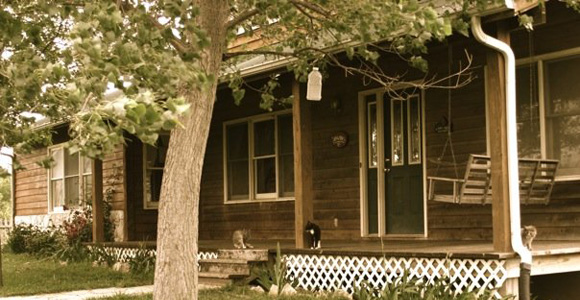
First of all, note that the front porch has no place in traditional architecture. It was a fleeting fad in the United States, first getting popular after the Civil War (c. 1865) and disappearing after the Second World War (c. 1950). When America's republican institutions were being founded, there were no front porches. Traditional Christian society in Europe never had front porches. I'll include some lovely images in this post to jog your memory, and you can check out this Web page, where I found most of them, to see more of the American architectural tradition. (Let me acknowledge: the untraditionalism of the front porch does not make it bad -- but it should make us think.)

The front porch's decline casts an interesting light on its rise. A key cause of the decline of the front porch, front-porch historians agree, was air conditioning. Climate control made it nicer to stay indoors than sit outside. A second cause was cars, which, with their noise and exhaust, drove people away from the front of their houses. A third reason, perhaps, was conspicuous consumerism, and the sense that the front porch looked too humble and old-fashioned -- ironically complimented by the cheapness of modern architecture, with its haste to cut unnecessary corners. A fourth was surely television, which made the indoors more entertaining. And a fifth, at least according to Deneen, was the transitory nature of post-automobile culture, where it no longer seemed worth the effort to get to know the neighbors.

Ironically, these reasons for the decline of the front porch also describe its beginnings.

Air conditioning drove people indoors -- but it was the heat that had driven them outdoors in the first place. It is worth noting that the front porch is originally a Southern institution -- historians think it may have been introduced by African slaves. Why had no one thought of this before? Well, everyone I've read agrees that a central part of the nineteenth-century evolution of the front porch was the advent of cheap building: previously, homes had been built of stone, which is naturally cool, but when they started being built more cheaply, other ways had to be found to beat the heat. (This is not central to my argument, but I note that the front-porch folks are usually pretty down on cheapness.)


In automobile culture, it is said, people had to flee to the back of the house when they wanted to be outside. But again, this highlights a significant irony. Historians agree that porches were initially put on the front of houses, not to be friendly to neighbors, but to hide from the back of the house. In the nineteenth century, that's where you kept the stinky horses and the outhouse. What's significant here is the motive for building front porches: purely utilitarian and private, not social. That doesn't change the social value of sitting out front, of course, but it should give one pause.

Television drew people indoors. What drew them out in the first place? Again, historians are unanimous: it was not a desire to socialize, but a desire to commune with nature, consistent with the nineteenth-century romanticism that created the Hudson Valley school of art and other forms of American naturalism. This point deserves further reflection, but before we move on, let us note in passing the connection to Deneen's claim that front porches declined when society got mobile: the time of the front porch was a particularly mobile part of American history, and it flourished most, not in the more stable towns of the East Coast, but in the West, where people were always on the move. One only needs to pick up a copy of Laura Ingalls Wilder, or peruse personal histories (I recently looked over the history of my Midwestern family) to see that these people couldn't sit still and were remarkably unpersuaded by the value of living close to family and old friends.

What drove the popularity of the front porch more than anything, say the historians, was a love of nature -- in fact, a way of thinking that explicitly opposed the dirt of man to the beauty of uncorrupt nature. Front porches were built, not to put people in contact with neighbors, but to help them glory in a world without neighbors. The front porch was a proclamation of glorious isolation, not republican community. Thus it is ironically consistent with the later-twentieth century's back porch, or patio: it was a way to be outside without seeing other people.

Indeed, a remarkable aspect of the front porch is that it goes hand and hand with a yard. In dense urban places where people don't have yards, front porches are almost impossible. And, from what I have seen of city living, where there are lots of neighbors around, it seems less pleasant to build a whole porch. Republic or no republic, people want a place to sit where there is some boundary between us and the world: whether an urban fence, a higher stoop, a balcony, or a suburban yard.

Having recently done some field research -- driving around old towns on the Hudson River where Victorian neighborhoods are still intact (I've done the same on the Shenandoah) -- it seems to me that late-Victorian suburban front porches were designed not to interface with the community but to help almost-city dwellers pretend they're out on the range. That's why these Victorian homes are built so far from the street, usually at a different elevation, and with as much yard as possible. The front porch as interface with the neighborhood is a lovely idea, but in fact, it was always used as a way to enjoy the distance of neighbors, cloaked, more or less perniciously, in the idea of nature's unsullied (that is, un-neighbor-ed) beauty.

I very much like Patrick Deneen's reasons for promoting the front porch, his ideas about life in community, an interface between public and private goods. But historically, I think the front porch better fits in with what the Greek political philosophers called "democracy" than with the idea of the res publica. Democracy means "mob rule," and the classic distinction is that a republic is about a common good, where individuals find their happiness in communion, whereas a democracy is about the majority snatching up private goods as fast as possible.


The front porch -- like the back porch -- is, historically, democratic, not republican. It's about individuals seeking pleasure through withdrawal from community. Perhaps it's no coincidence that the Victorian era, when the front porch was really popular, also saw the rise of progressivism, with its emphasis on destroying tradition and community in favor of a new kind of mass consumerism.

In place of the Front Porch, I submit the Sidewalk. In her magisterial The Death and Life of Great American Cities, Jane Jacobs lays out truly republican institutions. The chapter-headings of her first section make the point:
The Uses of Sidewalks: Safety
The Uses of Sidewalks: Contact
The Uses of Sidewalks: Assimilating Children
The Uses of Neighborhood Parks
The Uses of City Neighborhoods

City sidewalks are about people watching out for each other, people being in contact with one another, children getting to know the neighbors, and seeing fathers at work.

Mrs. Jacobs explicitly limits this discussion to big cities, but I've studied old small towns across the country -- from places like Pippen, Wisconsin (on the Mississippi, the town closest to Laura Ingalls Wilders's Little House in the Big Woods), to Putnam, Connecticut (a nineteenth-century mill town), to Staunton, Virginia, and Harper's Ferry, West Virginia (in the Shenandoah), to Bath, Pennsylvania (a farm town near the Applachians), to Newburgh, New York (on the Hudson) -- and one thing they all have in common is "urbanism." No matter how small, old towns are built around a dense core, where people give up their yards in order to live close together. Although it's a bit of an anachronism, we could say that what all old towns, small or big, have in common is the centrality of the sidewalk.

It is the sidewalk, not the front porch, that performs the republican functions Deneen so desires. It is the sidewalk, and the stoop, no matter how small, on front of the houses crowded against that sidewalk, that makes people neighbors.


The problem with the front porch is that it only exists where people are not crowded together. No yard, no porch -- and the yard, more than anything, shows a people who value privacy and separation from the neighborhood over communion and public life. Indeed, the problem with the yard is that it creates a world where no one walks. An urban environment, no matter the size, is defined by density and the close interface of work, leisure, and home -- so that people can walk from one place to another, and meet one another on the sidewalk.

Yards -- the almost-inseparable companions of front porches -- define neighborhoods where housing is separated from work and leisure (no one puts a yard in front of their store, or law office, or theater) and people define home by distance from other people. Yards add up quickly, killing the density that makes a neighborhood walkable and public.

And so the front porch, like the back porch, its successor, is not a republican institution, but a democratic one. However high-minded, the romanticism that fails to see this practical reality is the romanticism that has torn apart our vibrant urban neighborhoods.


Monday, January 25, 2010

Bumper Stickers

On a family car trip over the holidays, we were passed by a car with a pleasant bumper sticker about Jesus: nothing crazy, but clear, something like, "Jesus is Lord!"

As long time readers may remember, I am concerned about the anonymity of cars. We're so used to it that we don't notice, but sometimes it strikes me how truly nightmarish the highway is: surrounded by metal and glass, the world flying by at such a speed that we can't focus on anything, and only huge metal objects standing in the place of people. Science fiction could hardly conjure up a more dehumanized world.

So it momentarily struck me: perhaps bumper stickers are a good effort. If we can't talk to people, at least we can make clear that we are more than "Hyundai Elantra." Maybe in that depersonalized world, it's good to at least say something positive, and something that points to the transcendent. A bumper sticker could be a small step in the right direction.

But then it occurred to me. Little as I get to interact with other people on the highway, I am not entirely depersonalized. People see me driving the speed limit, and I see some of them crane their necks to see whether I am a little old lady or a middle-aged Chinese man. As little as I get to interact with them, they do see that I am neither of those things, and at least, perhaps, I raise the momentary question whether being a normal looking American requires that one ignore the law.

In that brief moment as they flash by, I think they get enough time to see the three car seats lined up across the back of our little hatch back. And I hope it at least raises a question, at least reminds them that some people still believe in family -- even choose family when it means we won't be able to afford a gigantic SUV.

I don't know what we look like from behind, but I think, during that minute it takes to get by us, that some people can see through our hatchback window the little wheelchair with my son's name emblazoned on it.

And I think, even in those brief glimpses of our humanity, it is perfectly clear that we are Christians.

Of course, I think it's all a lot healthier when we are pedestrians. Everyone on our block knows that we attend daily Mass: they see us, and talk to each other. (I know, because they tell me, in the bakery, where I actually talk to my real live neighbors.) Even if they've never talked to us, they know that we live by a different set of values, and they can guess pretty clearly what those values are.

So there's my bumper sticker, my "Jesus is Lord" t-shirt: my family, and the way I travel. Nothing against the guy with the bumper sticker, but I think we say it a lot more loud and clear.

Friday, December 18, 2009

Ethnicity in America: A Couple of Songs

In a post last May, I outlined a theory on how the Civil Rights movement was used to defeat ethnicity. Before Civil Rights, “race” described not the color of one’s skin or one’s genetic make-up – not anything merely physical – but culture: Italian, Irish, Polish, Russian, WASP. Civil Rights effectively eliminated all the immigrant ethnicities, collapsing American into Black and an amorphous White, WASP by default. Civil Rights killed off the ethnic neighborhoods.
Consider our new home, the Ironbound neighborhood of Newark, New Jersey. Fifty years ago, our older neighbors tell us, our street was Italian: in language, in cuisine, in religion, in culture. Now most of the Italians have fled to the suburbs, where a few pasta dishes and a funny name are all that distinguish them from the WASP culture that they once threatened. I think that’s a loss. I think peculiar culture is healthy, human – and important for preserving the more profound aspects of culture, morality and religion. The ultra-individualism of post-ethnic America leaves little room for tradition, reverence, mystery. And it leaves us isolated, like our old Italian baker around the corner: sometimes his old buddies come in from the suburbs; much of the time he sits alone in his shop, his family’s religion, language, and culture left behind in the days when he had a community.
The death of ethnicity, I submit, hasn’t been good for race relations. Black culture remains different, as it always was: ethnic culture. But that difference, I think, is harder for a homogenous majority-white culture to accept than it was for the ethnics of yesteryear, who were used to difference, who knew how to be uncomfortable with something without thinking it should be eliminated, “assimilated.” But I digress.
Today I would like to address a problem with this ethnic narrative: it threatens to forever pigeonhole people as Portuguese, Italian, or German. I think my point may most clearly be made through two songs that reflect the ethnic background of my wife’s and my families.
AN IRISH LULLABY?
My wife’s grandfather is from old Irish Newport, Rhode Island. My wife isn't sure whether it was his parents or his grandparents who were the immigrants, but they certainly lived in old ethnic America, where the cops were all from the neighborhood, and where it was a bit of a scandal when he went after my wife’s Austrian-WASP grandmother.
Grandpa O’Connors is a good-old-fashioned Irish tenor, and at a recent family gathering he got everyone to join him in singing “an Irish lullaby.”
Over in Killarney
Many years ago,
Me Mither sang a song to me
In tones so sweet and low.
Just a simple little ditty,
In her good ould Irish way,
And I'd give the world if she could sing
That song to me this day.
"Too-ra-loo-ra-loo-ral, Too-ra-loo-ra-li,
Too-ra-loo-ra-loo-ral, hush now, don't you cry!
Too-ra-loo-ra-loo-ral, Too-ra-loo-ra-li,
Too-ra-loo-ra-loo-ral, that's an Irish lullaby."
(Recording here.)
Very sweet. Here’s the problem: do you suppose anyone in Ireland ever sang “that’s an Irish lullaby”? Do you suppose they would have sung it in English? At first glance, this would appear to be, not a traditional song brought over from the home country, but a distinctly American glance backwards.
A small amount of research shows that it was written by a certain James Royce Shannon – birth name James Royce, “Shannon” added to make him sound Irish – of Michigan. He wrote it for a show in New York in 1913. Irish? Well, as near as I can tell, he was a Scottish-Rite Freemason – both ethnically and religiously committed to the destruction of Irish Catholicism.
Does that make it a bad song? Of course not. It’s lovely. Perhaps it’s even musically Irish. But this is hardly the survival of old-country traditions, hardly a bulwark of particularity and mysticism. With all due respect to Grandpa, it would seem to appeal to an Irish-ness that is Irish only in sentiment, but pretty well assimilated. An Irish-ness that doesn't remember Ireland.
And the song raises a further problem. Do you suppose back in County Kerry, they thought of themselves as “Irish”? I’m not sure. I’d guess they more often thought of themselves as being from Farranfore, Balleyheigue, or Lixnaw.
ON WISCONSIN
Enter another grandfather, this one mine. My family is thoroughly WASP. It’s been amusing for me, living now in New Jersey, with its heavily immigrant past, to try to explain to people that my family isn’t from anywhere – at least not anywhere overseas. Wisconsin, Minnesota, Illinois, Indiana. One set of my grandpa’s grandparents may (or may not) have come from Germany, and Grandma had a distant ancestor from Switzerland, but that isn’t too prominent in our family’s consciousness.
What’s important to Grandpa is that his parents met at the University of Wisconsin – where Grandpa and Grandma met, as did, incidentally, every one of Grandma and Grandpa's siblings and their spouses, my other grandparents, my step-father’s parents, my mom and dad, and later, my mom and step-father. I grew up an easy bike ride from UW. My grandfather somehow ended up with the copyright on a song you’ll surely never hear, entitled “My Home is in Madison” (“M-A-D-I-S-O-N, where the girls are the fairest the boys are the squarest of any home town I’ve been in”) – and it’s true, that’s our home. When my grandfather was getting ready to face death, he headed back to our “old country,” where his brothers were waiting for him.
My wife laughs that the fight song “On Wisconsin” (“plunge right through that line, run the ball clear down the field, boys, touchdown sure this time!”) along with its sequel, “If you want to be a Badger” (“just come along with me, by the bright shining light of the moon!”) are far more dear to my family, far more often used as bedtime songs and family-gathering rousers, than any “Irish lullaby” in her family. When I’m feeling nostalgic, I go to badgerband.com/music and click through all the old standards: “Varsity” (“U-rah-rah, Wisconsin! Praise to thee we sing!”), “You’ve Said It All” (“When you’ve said Wis-consin”), and “Songs to Thee, Wisconsin” (“Queen of all the West . . . May thy sons and daughters, in thy jubilee, See the dawn of greater, grander things to be”). When my grandfathers fought in World War II, I’m quite confident these were the songs that reminded them of their true homeland -- not anything about "purple mountain majesties."
THY SONS AND DAUGHTERS
I hope I’m not being prejudiced in favor of my family – though it is precisely such prejudice that I’m arguing for – when I say that I think this is about right. Ethnicity doesn’t mean wearing green on St. Patrick’s day, generations since the last person who knew what town in Ireland you came from – any more than my family’s culture is stuck endlessly in Danville, Illinois, or Duluth, Minnesota (the places my great-grandparents came from, before they met in Madison). It doesn’t mean allegiance to a vague nation like “Ireland”: a nation of four great provinces, thirty-two traditional counties, 32,000 square miles, and who knows how many thousands of little hometowns.
Ethnicity means being from somewhere in particular, with traditions, and roots. We don’t stay there forever – though it would do a lot for our culture if we could stay put for a few generations at a time. We should bring our traditions with us. My children, who have so far lived in Washington, D.C., and St. Paul, Minnesota, and who, I very much hope, will spend the rest of their childhoods – indeed, I hope, maybe much of their lives – in Newark, New Jersey, certainly know how to sing “On Wisconsin.” It’s where I’m from, who I am. But I doubt they’ll sing it to their children. They’ll root root root for the home team – Rutgers? Princeton? Seton Hall? – and, I pray, learn to think of themselves as from somewhere, with the traditions not only of our family but of our neighborhood.
An old definition (discussed in my May post) speaks of “A group of persons connected by common descent or origin; a family; a tribe or people; a group of tribes or peoples forming an ethnic stock.” Ethnicity means rootedness, knowing who you are and where you’re from, rejoicing in traditions, knowing that you are part of something bigger than yourself. The old immigrant populations give us a point of departure – but it is for our generations to live ethnicity in an American way, to be from Newark, or Madison, or Washington, just as our ancestors were not from Ireland, but Abbeydorney, Knocksnagoshel, or Derrynane, in County Kerry.

Friday, November 13, 2009

The Execution of the Beltway Sniper

I suppose this should be a separate post, commenting on part of the last one.

As a committed, faithful Catholic who takes Catholic social thought seriously, and as a professional theologian well-read in the Catholic tradition, I fully approve of the execution of John Allen Muhammad.

The Catechism of the Catholic Church, it is true, states, "If . . . bloodless means are sufficient to defend against the aggressor and to protect the safety of persons, public authority should limit itself to such means, because they better correspond to the concrete conditions of the common good . . . ."

But this is intentionally vague language: what is meant by "the concrete conditions"? Does that phrase not specifically distinguish the problems of a particular time and place as against the more general demands of justice? Thus the conclusion begins, not "always," but "Re vera nostris diebus": Today, in fact . . . .

But the Catechism begins its treatment of capital punishment by stating:

"Legitimate public authority has the right and duty to inflict penalties commensurate with the gravity of the crime. The primary scope of the penalty is to redress the disorder caused by the offense. When his punishment is voluntarily accepted by the offender, it takes on the value of expiation. Moreover, punishment, in addition to preserving public order and the safety of persons, has a medicinal scope: as far as possible it should contribute to the correction of the offender. [Thus] the traditional teaching of the Church does not exclude, presupposing full ascertaiment of the identity and responsibility of the offender, recourse to the death penalty . . . ."

We thus have an odd -- perhaps deliberately odd -- disjunction. On the one hand, the death penalty is unnecessary now because it is not necessary to protect other people. On the other hand, the death penalty is sanctioned by tradition not just, not even primarily, to protect other people, but for the sake of the offender.

And the tradition is full of stories of people converting precisely in the shadow of the gallows. Punishment is medicinal because it manifests the gravity of the crime and allows the criminal to make expiation, to redress the disorder caused by his offense. It is no coincidence, in light of this traditional teaching, endorsed by the Catechism, that the man to whom Jesus says, "Today you will be with me in paradise" is a criminal who "voluntarily accepts" his cross as just "expiation" for his crimes.

In this light, we might say it is the height of self-centeredness and injustice for liberals in our society -- who, along with their culture of death, have lost all conception of justice and virtue -- to try to deny a mass murderer the opportunity to suffer the just penalty of his offense. The true "correction of the offender" is not served by letting someone sit in jail for the rest of his life while society tells him we're afraid to think about the gravity of his crime. Ironically, Dead Man Walking, a film intended to be anti-death penalty, is a beautiful (if awful) depiction of precisely how the death penalty is society's way of expressing love for the criminal. Sean Penn's character, a reasonable depiction of many characters who have fallen to the depths of murderous depravity, is able to convert only in the shadow of the gallows.

I submit that it is a profoundly important aspect of social justice and serious Christian political philosophy that we value the conversion of the sinner over our own fears of getting our hands dirty. The political order exists to make people better, and to help them get to heaven.

I also submit that the key phrase in the John Paul II/Catechism concern about the death penalty might be "legitimate authority." John Paul II lived under the totalitarianism of the Soviets, with its absolute unconcern for the person -- including, certainly, for the "correction"and conversion of criminal offenders -- and then under the regime of liberal Old Europe, with its utter "loss of the sense of sin" (see John Paul's beautiful discussion of this at the end of Chapter Two in Dominum et Vivificantem). In these cases, capital punishment could never be approached as a kind of "redress," "expiation," and "medicine." But I simply assert: Virginia is a profoundly different culture from Soviet Russia.

Finally, I submit that Benedict XVI has intentionally made no mention whatsoever of John Paul's concerns about the death penalty, perhaps in light of a different cultural experience and a recognition that Soviet Russia does not define the modern world. In the 1950's, when these two great men were coming of age, the Soviet jackboots were crushing John Paul's Poland while the genuinely saintly Konrad Adenauer was prime minister of Benedict's West Germany; John Paul only emerged from behind the Iron Curtain when he was already an old man, in 1978, by which time all of Catholic Europe had fallen to secular liberalism. It does make for a different estimation of legitimate authority.

The Beltway Sniper and the Safety of Cities

On Tuesday of this week, John Allen Muhammed, the Beltway sniper, was executed.* I lived through the horror of those three weeks, when thirteen people were shot, ten of them killed, at random, in parking lots, gas stations, and other harmless places around the DC metro area.

Here's an interesting fact: it all happened in the suburbs. (Here's a list.) Okay, one shooting was on Georgia Ave., yards from the Maryland border. But it's interesting: urban folks were not the victims.

Why not? Because the sniper had to hide where no one could see him. There was one shooting very close to where we lived. The sniper sat in a vacant parking lot across a freeway from the Home Depot parking lot where his victim was getting into the car.

Here's where he sat:


View Larger Map

And here's where he shot:

View Larger Map

I really don't think is rocket science: the sniper needed vacant places. He found them in the suburbs; they are much harder to find in the city, and do not exist in truly urban neighborhoods.


We hear much of violent crime in the city, and are made to believe that every city dweller is likely to be the victim of stray bullets. My boss has warned me to lock my car doors and drive through red lights in Newark, since it's so likely that one of those scary black people will tear me from my car. But, I'm sorry folks, those incidents of random violence, though they happen, are extremely rare.

Think about this: South Orange Ave. in Newark (where my boss fears to tread) is about seventy feet across (from store front to store front). My body is (rounding up) maybe two feet across. Thus if I am standing directly perpendicular to a random gun shot flying down the street, my chances are less than one in thirty-five that it will hit any part of my person. That's if I happen to be standing where there is random gun fire. And of course if the gun is not pointed perfectly level, the shot will go over my head or his the ground before it gets me.

On the other hand, I-280 (an alternative route to work) has two lanes of traffic going each way; my car takes up one of those lanes. Thus my chances are 50/50 that an out-of-control car (such as a drunk driver) will hit me. And cars never go over your head, and are at least as deadly as bullets.

And honestly, what happens more often, random gun fire, or drunk drivers? I'm sorry to tell you that random gun fire is exceedingly uncommon, even in Newark.

At our very worst (and we are much improved) Newark had 161 murders among 280,000 residents; in an average year, New Jersey sees 771 traffic fatalities among its 8,700,000. Thus the average Newarker has a 1/1,700 chance of getting murder; the average Jerseyite has a 1/11,000 chance of dying on the freeway. If murders were as random as freeway accidents, you'd be 6.7 times safer living out of the city. But don't you think the randomness makes up for that small proportion? If nothing else, a freeway life is only marginally safer than a city life without freeways.


By the way, our working-class neighborhood of Newark (my family is well below the median income for the state of New Jersey) has a murder rate of about 1/12,000. Which makes you less likely to get killed in a decent neighborhood of Newark then on the freeway. And again, which is more random? Somebody has to point a gun at you to murder you; they only have to be playing with their cell phone or GPS to kill you on the freeway. I'll take my walkable neighborhood and my commute down South Orange Ave.

Perhaps the reason cities seem so much scarier than freeways is just the irony that what is less common sticks out in your mind more. When you hear that somebody's been killed on the freeway, you shrug: happens all the time. When someone gets murdered, it goes on the front page. That doesn't mean it's more common; quite the contrary.


*See the next post for a commentary on the execution of John Allen Muhammad.

Thursday, November 5, 2009

A Safe Place to Raise Our Children

One of the most compelling arguments against city living, I think, is the argument about protecting our children. A couple neighborhoods ago, we literally watched drug deals out our front window, right next to where our children play. The language was foul. Our immediate neighborhood was relatively safe, but shootings were frequent a few blocks away (anyone unfamiliar with the intense localism of city living would have said the shootings were in our neighborhood).

We live in a much better neighborhood now, but still there is pornographic graffiti all over the park. A very nice, but not very solid, neighbor gave our kids a bunch of comic books that were, ahem, not up to our standards of purity for our children's eyes. They weren't especially bad -- but it wasn't what I want my children to read. And if they get that stuff when they're four, it certainly makes me wonder what they will encounter when they're teenagers.

City life subjects us to all sorts of bad influences. It's no surprise that many people flee to the suburbs and the country, to protect their children.


But a recent discussion highlights the fallacy of that solution. My wife participates in an on-line community of homeschooling Catholic mothers -- diverse in many ways, but all solid Catholic moms, serious about doing what's best for their children. Recently a conversation came up that has come up many times before.

A mom writes in to say, hey, our closest parish is forty-five minutes away, but the priest is terrible; I'm getting to where I really can't subject my children to his bad preaching (or worse). And then they discuss their two or three options. In the many iterations of this conversation, there is typically an okay parish, but it's two hours away, and they're not sure they can make it to Mass every week (let alone every day). And lots of moms write in to say how they deal with similar situations.

We sit in our dense urban community, where we presently have (I do not exaggerate) eight parishes within a one-mile walk of us, and think, what an odd situation. Sometimes we try to think through the options, but end up shrugging our shoulders: it's hard to imagine having so few. At more lucid (or aggressive) moments, we think, if you really care about your children, maybe you shouldn't be putting your family in that situation. A thought, I suppose, parallel to what our peers in the country would say about us, if we complained about drug dealers and inappropriate magazines and graffiti: why don't you just move.

It is very uncommon for a family in the country to be bound there by a job -- jobs usually aren't any closer than parishes. Typically, they have moved to the middle of nowhere because they think it's a healthier environment for their children. But is it?


Perhaps they should live somewhere else. But where? Of course the immediate standard aspiration is, if only we could live in a tiny community where everyone is perfect. We know people who have tried to form such communities, in various situations: a suburban sub-development of only solid Catholics; a small town with one great parish; even, on occasion, attempts at building a farming community.

My first, and most natural, objection to those plans is on grounds of fideism. It is good to have Catholic friends and neighbors, to be sure -- but it's also good to have a soccer team, music teachers, theater, bookstores. It's good to have a decent hospital nearby (and I know people in these situations who have had major hospital problems, because their little utopia can't provide its own health care).

Dare I say it? It's even good just to have pagan neighbors, both to witness to and to learn from. In my experience, faith means more especially for children when they can see the depravity of their neighbors, the weakness of secular arguments, and even the frustration of the world around them -- when they care about people who don't have faith. A completely sheltered faith is not always the strongest faith. Some sheltering is necessary, of course -- but total sheltering from the outside world?

To put the same objection differently, lay people are not monks. There is an important place for those who flee the world and live only for prayer. But the Church is very explicit that such is not the vocation of the laity. We live to sanctify the world, to engage in politics, and culture, and labor, to witness to those who do not already have the faith. Abandoning that secular vocation of the laity is not good for grown-ups, and I do not see how it is a good way to teach children. The monastic vocation is itself corrupted (at least according to the teaching of the Catholic Church) if the world is treated as entirely evil. The laity are not monks, and monks need the witness of the laity.


But a second objection to the head-for-the-hills school of Christianity rests on the actual experience of monks. One cannot read far in monastic literature before one finds that even monasteries are not full of perfect people. St. Benedict, the founder of Western monasticism, was asked to lead more than one community that subsequently tried to kill him. That seems odd -- but it is the universal experience of monasticism. That has something to do with why monks are called monks -- from monos, alone: the monk submits to a rule, not because he thinks it will surround him with perfect people, but in order to seek God, as it were, on a single path. There are no communities of perfect people.

The experience of various Catholic communes makes this very concrete for the laity. I know quite well a small-town super-parish built almost entirely on the charisma of one man, a Ph.D. in theology. But that man is now senile, and dying. Now what? Is it good for a family to be in such need to one charismatic leader? And is that Catholic? To make things worse, the man's theology is not especially sound. He propounds many things as Church teaching which are not Church teaching, and which are sometimes directly contrary to Church teaching. My friends who are in this situation are not theologians; what can they do but submit to their hero's opinion? They are in good will: but they have put themselves in a situation where one man's error becomes their Gospel, because he is the only show in town.

Similarly, if we move to a perfect parish: what if the priest falls ill? What if he's weak on some points? Do these people realize that everyone has weaknesses, that the Church has never recommended that you submit yourself wholly to any mere mortal? (Even a monastic abbot is elected by the community, and hedged by many external authorities; and the classic understanding of monastic obedience is external not internal -- one always has the right to question the abbot's judgment, and so ultimately to leave, in extreme cases.)

A perfect suburban Catholic sub-development always runs the risk that one of the six families you've built your entire world around might turn out bad. There are no communities of perfect people.


That's not to say we shouldn't have friends. We should. We must. But friendship should lead us outward, into society. We should seek a place where we can make friends, not a place where we are left alone, whether to our own devices (in perfect rural isolation), or to fallible human pastors, charismatic leaders, and friends.

Living in the city subjects my family to certain risks, against which I must protect them. I might stay away from some graffiti, and from certain neighbors. I certainly need to train my children to discern right from wrong (though I submit that the drug dealers and playground graffiti really aren't all that tantalizing, especially to someone who has any life at all).

But in the city, I have resources. In the city, I don't have to be friends with everyone I see. In the city we can turn away from certain bad influences and towards others. In any form of commune, one can only flee from one bad influence by fleeing one's entire life. I just don't see how that makes for a safe place to raise our children.

Friday, October 23, 2009

The Nets, the Rock . . . and the Parking Lots

Things are looking good for bringing the NBA New Jersey Nets to Newark's Prudential Center (known locally as The Rock). The Nets currently play at the Meadowlands -- "meadow" being Northeastern New Jersey's euphemism for the broad swaths of swamp that have prevented serious urban development, for good or for ill, in much of an otherwise-dense area. In other words, the Meadowlands is a bunch of sports complexes surrounded by a beautiful expanse of not much of anything.

The Nets are planning to leave the Meadowlands for a new stadium in Brooklyn, but that stadium has yet to be built, and is currently mired in an eminent-domain court case; it might never happen. In the meantime, it looks like the Nets might come to Newark, at least for a couple years.

There would be considerable advantages for the city. The costs of the Prudential Center are already mostly in place, so almost all the tax revenue brought in by basketball tickets goes straight to the bank for the people of Newark. Last year over 620,000 people attended Nets home games, with tickets ranging from $10 to $500; that's a lot of tax revenue.

It's also a lot of potential business for Newark's downtown and the stadium area. Here's a satellite image of that area (sorry, I couldn't get googlemaps to get rid of the bubble):


It's actually a little hard to make out the stadium itself; I think it's the longish shiny building to the left and slightly above the red 'A.' Just behind the "Map - Sat - Ter" buttons are some tall buildings: that's downtown. And a little further down the right side of the screen is Newark Penn Station; the train tracks come out beneath and slightly to the left, toward the bottom of the image. Newark Penn runs fast, cheap PATH trains to several stops in Manhattan, about half an hour away; it is also a hub of the vast NJ Transit system, with slightly less cheap trains arriving from all over the state.

Which is all to say, this site is very different from the Meadowlands. Here, the stadium is connected to a city, a city that could greatly benefit not only from ticket tax revenue, but also from people coming to bars, restaurants, and even shops around the Prudential Center. And here the stadium is two blocks away from a major transit hub.

And yet notice one other detail on that map: blocks and blocks of parking lots.

The parking lots change the stadium from an asset to a liability for Newark's downtown area. This stadium could potentially draw hundreds of thousands of basketball fans every year. It already brings in about 640,000 fans of the NHL New Jersey Devils hockey team (40 home games a year x almost 16,000 people per game), plus fans of a smalltime soccer team and a local college basketball team, and concerts such as (in the next couple weeks) a couple shows by teen-pop star Miley Cyrus and no fewer than eight performances of Disney on Ice. This place should be surrounded by businesses catering to all these literally millions of visitors to Newark.

But what they find is just what we who live in the city find: blocks and blocks of parking lots. I recently attended an evening event at Newark City Hall - just across one of those parking lots from the Rock and less than a mile from my home. I would gladly have walked, if I were walking through blocks of businesses, homes, and people. But I am not foolish enough to walk at night through empty blocks of parking lots. And we cannot expect Newark's visitors to be stupid enough to cross all those parking lots before getting to area businesses. It isn't interesting, and it isn't safe.
Take out the parking lots. Sell them to whoever wants to be near the stadium. There might be a market for housing, there's surely a market for bars and restaurants, there might even be a market for retail. Let people park at one of the 163 other stations in the New Jersey Transit system, and take the train to Newark.

The Prudential Center ought to tie in with the neighborhoods around it. Businesses around the stadium ought to lure visitors out toward the neighborhoods -- downtown, the beautiful "Coast" to the South, the Ironbound -- and lure people from the neighborhoods in toward the stadium.

Our neighborhood, the Ironbound, just over those train tracks to the east, is one of the healthiest, most vibrant residential and restaurant neighborhoods in Newark. People from the neighborhood should be walking to events at the Pru, and frequenting the businesses that surround it. And businesses between the Pru and the train tracks ought to be encouraging visitors to venture east, until some of them start to cross the tracks and stimulate businesses in the Ironbound.

Instead, the parking lots serve as a "border vacuum," sucking life out of everything around them. The train tracks are a liability for the neighborhoods already: they make for a full block of walking with nothing to do, no decent people around, etc. If there was life on both sides, people would cross under. Instead, there are blocks and blocks of parking lots, sucking life even out of the train-track border of our neighborhood.

Here's the punchline: Cities need to cater to pedestrians. If you have public transportation, use it, to give people more access to the street. And be mindful of the negative effect of requiring pedestrians to cross blocks and blocks of nothing in order to get from one place to another. It isn't interesting, it isn't safe, and it sucks the life out of an urban environment.